Showing posts with label science. Show all posts

May 4, 2009

The Constitution Commandeth: Thou Shalt Not Call Creationism "Superstitious Nonsense"!

I woke up from blogging hibernation because another Bush-appointed judge decided that we've always been at war with Eastasia.

As Orwell said, freedom is the freedom to say that two plus two make four. If a teacher is not allowed to say that creationism is "religious, superstitious nonsense", then we are in deep trouble. And, as of last Friday, a teacher is not allowed to say that, at least not in the Central District of California.

Briefly, James Corbett, a high school history teacher and adviser for the student newspaper, was found liable for Establishment Clause violation because of the comment he made in reference to John Peloza, a biology teacher who has been fighting (and suing) the school district for his "right" to teach creationism in his science class.

The most important reason this ruling is appalling is that it prohibits telling the truth. PZ Myers nails it:
First of all, he told the truth: creationism is religious, it is a product of superstition, and it is nonsense — it doesn't fit any of the evidence we have about the history of the world or life on it. We have to have the right to tell students not only that something is wrong, but that it is stupidly wrong.
And the judge's reasoning is mind-boggling (emphasis mine):
The Court cannot discern a legitimate secular purpose in this statement, even when considered in context. The statement therefore constitutes improper disapproval of religion in violation of the Establishment Clause.
Hello? The context, as described by the judge himself, was Corbett's opposition to Peloza's attempts to teach creationism. Not only is creationism false, but teaching it in public schools - especially in a science class - is illegal. Pointing this out obviously has a secular purpose.

So much for one prong of the Lemon test; the judge sours the next one just as badly:
The Court finds that Corbett’s statement primarily sends a message of disapproval of religion or creationism. As discussed above, Corbett states an unequivocal belief that creationism is “superstitious nonsense.” Corbett could have criticized Peloza for teaching religious views in class without disparaging those views.
This is wrong on several levels. First, it is beyond dispute that, in the context of science, which is what Peloza was supposed to teach, creationism is superstitious nonsense. If it weren't, the fact that it is illegal to teach it would be hugely problematic. If those views did not deserve disparaging, Peloza would be a victim of persecution by the Capistrano Unified School District, the US District Court for the Central District of California (the same one that decided this case) and the Ninth Circuit Court of Appeals. There is a reason creationism is not allowed in the science curriculum.

(And, to preempt the argument that it has nothing to do with truth or falsehood, but only with favoring religion, let me ask if teaching some claim that came from a religion - and, to make the case harder, was denied by another religion - would still be prohibited if the claim turned out to be true. Let's say science discovered that it really was turtles all the way down; would it make any sense to proclaim that teaching that violates the Establishment Clause?)

Furthermore, if so many non-fundamentalist believers and conciliatory non-believers have been trying to convince the public that religion is compatible with evolution, how come disparaging creationism is equated with disparaging religion? Again, I'll outsource this to PZ:
[W]e are being told over and over again that Christianity is not equivalent to creationism. This teacher has specifically said that creationism is nonsense, and this judge has equated a dismissal of a weird anti-scientific belief with making a rude remark about Christianity. So…where are all the Christians rising in outrage at the slander of their faith?
Finally, this suit was not brought by Peloza, but by a student, Chad Farnan. It is a mystery why Farnan should have standing to sue over a disparaging statement one teacher made about another teacher.

Ed Brayton wrote about the decision as well, but he seems terribly confused for a normally staunch free speech proponent. While Ed seems to tepidly agree that the creationism comment did not violate the EC, he also seems to think that some of Corbett's other comments, which the judge found not to have violated the EC, were more problematic:
Again, this is really strained reasoning. If he really wanted to make the nuanced point that the court thinks he was making, he could certainly have done it in a much more scholarly and serious way. Instead, the statement he made was inflammatory and insulting. There just isn't any place for that kind of hostility in a public school classroom.
The way I read it, Ed would have found Corbett liable at least for the "Jesus glasses" comment. That is very disappointing, even more so because he stops at hand-waving and makes no attempt to argue with the Court's actual reasoning. Not surprisingly, a lot of Ed's commenters agree with him, many of them flaunting their ignorance of the facts (e.g., implying that Corbett was a science teacher). I will reproduce my comment here:
Why would the "Jesus glasses" comment be inappropriate? Jesus (if he existed, or other people in his name) promoted a certain set of moral rules that are demonstrably impossible to follow without acting against one's best interest, as the vast majority of Americans understand "one's best interest". It should be a history teacher's duty to explain why a certain group acted against its own interests - at least as it would appear to us. Unless there is evidence that "they were blinded/manipulated by religion" is not a fair explanation, i.e., not one widely accepted by historians, the teacher should be free to teach it.

As for the Mark Twain quote, as long as it is a true quote, it ought to be fair game for a teacher to use it. After all, Twain is arguably the greatest American writer ever (certainly the most acclaimed word-wide), and is (hopefully) well-represented on the syllabus of some required courses. Shouldn't students learn that the greatest American writer was an atheist?
But don't take my word for it, go to the source and read the decision.

UPDATE (5/5/09): As usual, Digby gets it.

Aug 3, 2008

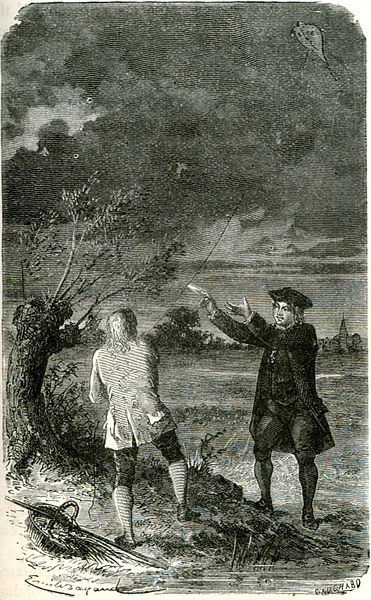
Swimming with Ben Franklin

I headed to the pool yesterday, in mostly sunny weather, but just when I got there, distant thunder could be heard. The lifeguard followed the standard procedure and ordered all the people out of the pool before I could get my toes wet. I didn't have time to stay and wait for half an hour or more, so I turned around and walked home, not getting the 20-30 minute swim I had hoped for.

I wonder whether this risk-averse policy of preventing lightning strikes in the pool makes sense. To answer that question, we need some quantitative measures of risk, not just an explanation why it is risky to be in water in or near a thunderstorm. Of course, being in water increases risk, but by how much? There are indications that expert advice tends to be more risk-averse than most people would be willing to follow. For example, the National Lightning Safety Institute says that cars are safe (because of their metal shell), but only if you
close the windows, lean away from the door, put your hands in your lap, don't touch the steering wheel, ignition, gear shifter, or radio.

That means you shouldn't drive in a storm. But how realistic is that? Imagine the traffic coming to a standstill every time a thunderstorm is near. Similarly, if you are at home, you shouldn't take a shower or wash your hands during a storm, because plumbing is part of the house's conductive shield, and touching it - directly or through water - puts you at risk. But seriously, how many people have died or been injured by lightning while washing hands at home?


Numbers matter because foregoing unsafe actions is usually costly. If traffic stopped in storms, there would be significant economic losses, and moreover (if you think money is not worth the risk), parents would be late picking up children from day care and patients would not get to hospitals on time. Not washing hands may increase your risk of getting ill, which may - depending on the numbers - outweigh the risk of getting shocked by lightning. Similarly, in my case, I am not sure if foregoing swimming to reduce the risk of lightning was a net benefit to me.

Exercise is healthy; it improves life expectancy as well as the quality of life. I estimate that half an hour of swimming would have increased my life expectancy by a few minutes. My reasoning for that estimate uses the analogy with smoking. It is often reported that smoking one cigarette shortens your life expectancy by about 10 minutes. (That's consistent with the assumptions that an average smoker smokes 20 cigarettes per day for 40 years and lives about 6 years less than a non-smoker with the same characteristics.) While I have no data supporting this, it seems intuitively plausible that a good aerobic exercise session would improve one's health by about the same order of magnitude as one cigarette would damage it.

Now, my life expectancy is about 20,000,000 minutes, so I should be willing to risk a one-in-a-few-million chance of being struck by lightning to obtain the life-prolonging benefits of exercise. And so far, this calculation doesn't take into account the pleasure derived from swimming. We pursue pleasures involving risk of death every day. Driving 7-8 miles to the mall or theater implies about 1 in 10 million chance of dying in a car accident (and a much higher chance of being injured). 5,000 food poisoning deaths per year in the US amount to about 5 per meal (1 in 60 million), with serious illness requiring hospitalization being 60 times as likely. And I am not even talking about activities that are normally perceived as risky.

What about lightning? It is hard to find relevant statistics. About 1 in 6 million Americans is killed by lightning every year, and about 8% of those deaths are water-related (but 40% are "unknown"). However, a lot of the water-related lightning accidents occur on small open boats, so it is unclear how many are swimming-related. And, of course, most people take safety measures, so it is hard to know the exposure underlying those accident statistics. They don't help with the specific question I had:

What is the probability of being struck by lightning during a single 30-minute swim in an outdoor swimming pool when a thunderstorm is nearby?

If this risk is of the order of one in several million, it is better to swim anyway. If it is, say, one in a hundred thousand or less, the standard safety procedures make a lot of sense.

I could make it more precise by listing several other factors. Lightning was not visible and by the rolling sound of thunder, I am pretty sure the storm was more than 5 miles away. The pool is lower than most surrounding areas, including the pool house. A train station is just about 200 yards away, with various structures likely to attract lightning. There are plenty of houses, trees, and electric lines in the vicinity - it is a densely populated area. It seems to me that all those factors reduce the risk of a direct strike to the pool (and thus of a deadly strike to the swimmer), although some of them might increase the risk of a strike close enough that some charge might find its path through the pool (but this would seem to be more relevant to the risk of lighter injuries).

Does anyone have some relevant quantitative data?

Jul 28, 2008

Dog bites man: miles per gallon edition

A Duke University study, published in Science and reported in the Consumer Reports, found that miles per gallon are misleading and that consumers would make better decisions if fuel consumption were posted in gallons per mile.

Well, duh. Shouldn't that be obvious?

Is it any surprise that people calculate better with direct quantities than with inverses? Miles per gallon is an inverse measure of the cost of fuel, so one doesn't have to be a rocket scientist to figure out that consumers will have more trouble making rational decisions based on that measure than based on a direct measure of fuel consumption, such as liters per 100 kilometers, which is used in Europe and pretty much the rest of the world.

Most people don't realize (at least not immediately) that driving 45 mph from Startington to Endington (distance: 60 miles) and 80 mph on the way back takes more time than driving 60 mph both ways. But they do realize that a 80-minute trip and a 45-minute trip together take longer than a two-hour trip. Similarly, people don't realize that going from 12 to 16 mpg is a greater saving than going from 24 to 32 mpg, but they would recognize immediately that going from 20 to 15 l/100 km is more significant than going from 10 to 7.5 l/100 km. Elementary, my dear Watson!

Dec 12, 2007

This Just In: Pregnant Women Don't Tip Over!

We'd never know, but this article reports it is so. More seriously, the source is in the Dec 13 issue of Nature, and it's all about spine curvature. Well well...

Anecdotally, most men find something attractive about a pronounced curvature of a woman's lower back, just above the buttocks. If I understood this article correctly, that's another evolutionary marker of an efficient "baby-making machine". Other such markers I've heard of before are full lips and a high hips/waist ratio; all of them are correlated with fecundity, as well as universally considered attractive.

We men may be pigs, but it is in the noble function of propagating the species. Our tastes evolved. Guys, when women tell you to evolve, you should retort, "I already have. This is the final product." (So far, of course, but the same is true of women.)