There it is - America's most dangerous jobs in 2007:
Also note that police officers' most common cause of death on the job are car accidents, not confrontation with criminals. Police officers' rate of death by homicide - about 8 per 100,000 - is just slightly above the rate for the general population (6.2 per 100,000), and is lower than the rate for general male population (10.0 per 100,000) or male population ages 20-59 (about 11 per 100,000).
Showing posts with label facts. Show all posts
Showing posts with label facts. Show all posts

Nov 5, 2008
Dodo alert
What is happening to the moderate Republicans? How did those from the top of the Republican part of the 110th House rankings do in this election?
For comparison, of the 12 most conservative House members, 11 were easily reelected; only Bill Sali from Idaho lost (to Democrat Walt Minnick).
Moderate republicans are going the way of the dodo.
- Wayne Gilchrest (MD-1) lost in the primary to the conservative Andy Harris. Harris is currently trailing Democrat Frank Kratovil by 915 votes.
- Jim Ramstad (MN-3) did not run for reelection. In his district, Republican Erik Paulsen defeated Democrat Ashwin Madia. Paulsen's campaign involved some dirty advertising, not a good sign for moderation.
- Frank Lobiondo (NJ-2) was reelected.
- Chris Smith (NJ-4) was reelected.
- 38-year-old Mike Ferguson (NJ-7) did not run for reelection. State Senate Minority Leader Leonard Lance kept the seat for the Republicans. Lance appears to be a moderate.
- Jim Saxton (NJ-3) retired. John Adler won the seat for the Democrats.
- John McHugh (NY-23) was reelected.
- Jim Walsh (NY-25) did not seek reelection. Daniel Maffei picked up the seat for the Democrats.
- Mark Kirk (IL-10) was reelected in a replay of the 2006 tight race against Dan Seals.
- Tim Johnson (IL-15) was easily reelected.
- Chris Shays (CT-4), the Last of the New England Republicans, lost to Democrat Jim Himes.
- Dave Reichert (WA-8) is leading Darcy Burner by less than 2000 votes with less than half of the precincts reporting. This is looking like a replay of their 2006 race, which Reichert won by 2%, but it may be even closer this time.
For comparison, of the 12 most conservative House members, 11 were easily reelected; only Bill Sali from Idaho lost (to Democrat Walt Minnick).
Moderate republicans are going the way of the dodo.
TAKS and KKK effects
The TAKS effect: Every state that starts with "T", "A", "K" or "S" voted for McCain. There are 10 such states and they comprise 98 electoral votes. McCain won those states' popular vote by a margin of 14%.
Eliminate TAKS, and the rest of the country voted for Obama by a 10% margin (compared to the 6% for the whole country). The electoral vote count is 349-64 (with 27 yet to be determined).
The KKK effect: Every state with a "K" in its name voted for McCain. There are 8 such states and they have 41 electoral votes; McCain has won 40, while one from Nebraska is still uncertain. McCain won those states by 19%.
Eliminate KKK, and the rest of the country voted for Obama by an 8% margin, with the electoral vote count is 349-122 (with 26 yet to be determined).
Eliminate both TAKS and KKK, and Obama wins by 11% and 349-50 electoral votes (with 26 pending). Additionally, the 55-40 advantage in the Senate becomes 49-21, and the 245-157 advantage in the House becomes 219-121. (Pending seats not counted.)
Well, Mr. President, you may say there are no red states and blue states, but there sure are TAKS states and KKK states, and they don't like you very much. The rest of the country looks pretty normal.
UPDATE (many months later): Oops, not every state with a "K" voted for McCain. Thanks to Samer for correcting me.
Some trivia about the 2008 Presidential Election
As of early afternoon of The Day After Election, Obama has 63.4 million votes (52.4%) to McCain's 56 million (46.3%). As expected, Obama has exceeded Bush's 2004 record of 62 million votes. McCain got more votes than Reagan in 1984, but needs 3 million more to surpass John Kerry's 2004 count.
I am not sure what is going on with the turnout. AP is reporting estimates ranging from 134 to 137 million, but so far only 121 million votes have been counted. Is it possible that 10% of the votes haven't been counted yet? All states except Washington, Oregon and Maine have reported more than 90% of precincts, and the only others below 98% are California, Colorado, Arkansas, South Carolina, and New Hampshire. If the final vote tally increases by 10% in proportion to the votes already counted, Obama could end up with close to 70 million, and McCain could equal Bush's 2004 numbers. Alternatively, there could be a lot of invalid ballots and the estimates could fail to take that into account.
If the current popular vote percentages hold, it will mean that the pollsters were very accurate. The pollster.com average was 52.0-44.4; RealClearPolitics average was 52.1-44.5; and FiveThirtyEight.com projections were within 0.2% of the actual results. The best individual pollster was Rasmussen, whose latest poll was 52-46 for Obama, which means no error other than rounding.
Most state polls were excellent, too, at least for us who relied on FiveThirtyEight's aggregation methods. The three states that were supposed to be extremely close - MO, IN, NC - are still uncertain. Polls also did very well in most states that were expected to be close (OH, FL, VA, CO, MT, GA) or that McCain hoped would be close (NH). Obama outperformed the polls in Pennsylvania (by 4%), Nevada (by 5%) and New Mexico (by 6%), while McCain did better in Iowa (by 4%), Arizona (by 4%) and North Dakota (by 7%). It also seems that, in the states won by large margins, the winner typically outperformed the polls, but of course there were fewer polls in those states and they may not have been done as carefully.
As many have pointed out, Obama's share of the popular vote is greater than any Democrat's since 1964 and greater than any non-incumbent's since 1952 (if we count the sitting Vice President, i.e., Bush in 1988, as an incumbent). More impressive fact, in my opinion, is that, since Andrew Jackson, only two Democrats - FDR and LBJ - have won a greater share of the popular vote.
(Total nerds will also find noteworthy that in the last 10 presidential elections (since 1968), only Reagan in 1984 and Bush in 1988 got a higher percentage of the vote. Obama's popular vote margin is greater than Clinton's in 1992 and, if he ends up winning all three uncertain state, his electoral vote advantage will be greater as well.)
Obama outperformed Kerry in 44 states and DC. The only states where he did worse were Arkansas, Louisiana, Oklahoma, West Virginia, Tennessee, and (probably) Alaska - and all but the first two were within 1 percentage point of Kerry's result. By contrast, he outperformed Kerry by 39 percentage points in Hawaii, by 22 in Indiana, 19 in North Dakota, 18 in Montana, 17 in Nebraska, 16 in New Mexico, Utah and Vermont, and 15 in Delaware and Nevada.
Obama won the majority of states, only the third Democrat since Truman to do so. (The other two were LBJ and Clinton.)
Obama did better in Delaware, DC, Illinois and Vermont than any Democrat since 1856 (when Democrats and Republicans emerged as the two major parties). His margin of victory in Delaware was second-highest for either party since 1856. (Hoover in 1928 won by 30%.)
It was the best Democratic result in California since 1936 and the second best ever (unless the final results lower the margin from the current 24% to below 21%, which was FDR's 1932 margin).
No Democrat has done better since 1964 in CO, CT, HI, IN, MD, MI, NE, NV, NH, NM, PA, VA, WI, and probably OR (where Obama seems almost certain to exceed Clinton's 10% margin from 1992). That is 14 states, in addition to the 4 (+DC) already mentioned.
It was also the second-best Democratic result "ever" (meaning since the later of statehood or 1856) in CT, HI and NH, third-best "ever" in ME, MI and NY, fourth-best "ever" in NM, PA and WI, and fifth-best "ever" in MD, NJ and OH.
It was the second-best result for a Democrat since FDR's time in CO, IN, MD, MI, NV, NM, PA, WA and WI.
In Nebraska, it was the second-best Democratic result since 1948 and third-best since 1940.
In Florida, it was the third-best Democratic result since 1948 (and better than in 1964).
In Utah, although Clinton lost by smaller margins, the Democratic share of the vote was the highest since 1968; in Texas, it just about equals Clinton's in 1996 (43.83%), which was the highest since 1976. And the result in North Carolina is the best for a Democrat since 1976.
On the other hand, Arkansas is the third-worst ever for a Democrat, Oklahoma is looking about the same as 2004, which was the third-worst ever (in both cases, only 1972 and 1984 were worse), Louisiana is the fourth-worst ever (after 1968, 1972 and 1984), Tennessee is the second-worst since 1868 (only 1972 was worse), and Kentucky and Wyoming were the worst of any year in which the Democrat won.
As the Republican streaks ended for Virginia and (probably) Indiana, the most reliable Republican states remain AK, ID, KS, NE, ND, OK, SD, UT and WY. The nine (the Nazgul?) have voted Republican in every election since 1968, 11 times in a row. By contrast, the most reliably Democratic state has been Minnesota (9 elections, since 1976) and the most reliable jurisdiction DC, which has voted Democratic in every election since the 23rd Amendment (12 elections, since 1964).
Nov 3, 2008
Presidential election trivia III: odds and ends
From 1992 to 2000, in 3 straight elections, no candidate got 50% of the vote. The only other time that happened was in the 4 straight elections 1880-1892.
Major party candidates who lost their home state:
Republicans have dominated the West since the 1920s, except for the Roosevelt-Truman years. ND-SD-NE-KS formed the "axis" that Republicans won even in 1940-48. Those 4 states went Republican in every election since 1920 except 1932, 1936, and 1964. In 1948, Oregon was the only other Republican state west of the Mississippi, but since then the West has been strongly Republican. Here is the list of Democratic states west of the Mississippi since 1952:
Major party candidates who lost their home state:
- Pinckney (1804 and 1808)
- Rufus King (1816)
- Van Buren (1840)
- Clay (1844)
- Scott (1852)
- Fillmore (1856) - but he wasn't a major party candidate then
- Fremont (1856)
- Breckinridge (1860)
- Douglas (1860)
- McClellan (1864)
- Greeley (1868)
- Hancock (1880)
- Cleveland (1888)
- Benjamin Harrison (1892)
- Weaver (1892) - not a major party candidate, but won EVs elsewhere
- Bryan (1900)
- Parker (1904) - both candidates were from NY
- T. Roosevelt (1912) - not a major party candidate in that year
- Taft (1912)
- Wilson (1916) - the only one to win the election despite losing his home state
- Cox (1920) - both candidates were from OH
- Davis (1924)
- Smith (1928)
- Hoover (1932)
- Landon (1936)
- Wilkie (1940)
- Dewey (1944)
- Stevenson (1952 and 1956)
- McGovern (1972)
- Gore (2000)
Republicans have dominated the West since the 1920s, except for the Roosevelt-Truman years. ND-SD-NE-KS formed the "axis" that Republicans won even in 1940-48. Those 4 states went Republican in every election since 1920 except 1932, 1936, and 1964. In 1948, Oregon was the only other Republican state west of the Mississippi, but since then the West has been strongly Republican. Here is the list of Democratic states west of the Mississippi since 1952:
- 1952: AR, LA
- 1956: AR, MO
- 1960: AR, LA, MO, MN, TX, NV, HI
- 1964 (Exceptional year - D landslide): all except AZ, LA
- 1968: TX, MN, WA, HI (and Wallace won LA, AR)
- 1972: none
- 1976: TX, HI, MN, MO, AR, LA
- 1980: MN, HI
- 1984: MN
- 1988: HI, WA, OR, MN, IA
- 1992: HI, WA, OR, CA (the Pacific states have become safe D territory), NV, MT, CO, NM, and "The Man" (MN, IA, MO, AR, LA)
- 1996: Pacific + "The Man" + NV, AZ, NM
- 2000: Pacific + NM, MN, IA
- 2004: Pacific + MN
Presidential election trivia II: states and electoral votes
Only 3 states have held the distinction of being the state with the most electoral votes: Virginia until 1808, New York 1812-1968, and California since 1972.
1812 was the first election in which some electoral votes came from west of the Mississippi - from Louisiana.
The second state west of the Mississippi was Missouri (first voted in the 1820 election), the third was Arkansas (1836), followed by Iowa and Texas in 1848 and California in 1852.
States that voted for the first Republican presidential candidate (John Frémont) in 1856: all of New England, plus Ohio, Michigan, Wisconsin, and Iowa. All except OH look reliably Democratic for 2008. All except OH and IA voted Democratic in 2004. All except OH and NH voted Democratic in 2000. All voted Democratic in 1992 and 1996.
Free states that voted for James Buchanan in 1856: Pennsylvania (his home state), Illinois, Indiana, New Jersey, and California (Frémont's home state). In 1860, Lincoln won all of them (NJ split its electoral votes 4-3 in Lincoln's favor).
States Lincoln lost in 1864: Kentucky (where he was born), Delaware, New Jersey. He won Missouri and Maryland although they were slave states. He won West Virginia which was still a slave state, although it was formally committed to abolishing slavery. He also won Kansas, where the status of slavery was violently contested before the Civil War.
1872 was the first time New Jersey went completely Republican and the last time until 1928 that Virginia voted Republican.
Southern states that never voted Republican during the Civil War or the Reconstruction: Georgia and Kentucky.
In 1876, Connecticut voted Democratic, the first New England state to do that since the emergence of the Republican Party.
In 1880, the South solidified Democratic. It was also the first time Nevada voted Democratic, and the first time California did so since 1856. The only time CA went D between 1880 and 1916 was in 1892, when it split its electoral votes 8D, 1R.
In 1900, the two Dakotas voted for the same candidate for the first time (in 1892, ND split its votes 3-way and SD voted R; in 1896, ND voted R and SD voted D; in 1900, they both went R.) They voted together in every subsequent election except 1912 (when ND voted Democratic and SD Progressive) and 1916 (ND-D, SD-R). Almost all those votes were for the Republican, except in 1932, 1936, and 1964.
In 1904, Missouri voted Republican for the first time since 1864. Teddy Roosevelt solidified the West - he won all states west of the Mississippi except Texas, Arkansas, and Louisiana. Roosevelt was the first candidate to win more than 300 electoral votes.
In 1912, Woodrow Wilson became the first candidate to win over 400 electoral votes (435 out of 531) and to carry 40 states (out of 48), despite winning only 41.8% of popular vote (which was the lowest percentage for the winner since Lincoln in 1860).
All New England states except Vermont went Democratic in 1912. Other than Connecticut, they had not done so since 1852. Massachusetts had not voted Democratic since 1820 (and in a contested election not since 1804). Ohio also went D for the first time since 1852.
Only Vermont and Utah voted Republican in1904 1912. (Six other states - PA, MI, MN, CA, WA, SD - voted Progressive.)
From 1856 to 1908, these were the only instances of states that border Canada voting Democratic:
In 1912, Woodrow Wilson became the first candidate to win over 400 electoral votes (435, out of 531) and to carry 40 states (out of 48) despite winning only 41.8% of the popular vote.
In 1916, the only Republican states west of the Mississippi were OR, SD, MN and IA; the West almost solidified D in a near-reversal of 1904. However, all of Northeast (except NH) was back in the Republican column.
Wilson won in 1916 despite losing his home state (NJ); he was the only presidential candidate ever to do that. Charles Hughes became the first candidate to lose despite winning more than 200 electoral votes (254). Only Al Gore won more EV while losing the election (267); had Florida been counted properly, the 2000 election would not have been as close as the 1916 one.
In 1920, Tennessee went Republican for the first time since 1868, and Oklahoma for the fist time since it became a state. The West was again solidly Republican as in 1904. Harding became the first Republican to win more than 400 EV.
In the three elections of the 1920s, the only Democratic electoral votes outside the Confederacy came from Kentucky in 1920, Oklahoma in 1924, and Massachusetts and Rhode Island in 1928.
1928 was the first election in which Texas and Kentucky voted Republican; Texas didn't go Republican again until 1952 and Kentucky not until 1956. Also, FL went R the first time since the controversial 1876 and NC and VA the first time since 1872. Hoover won more EV (444) than any Republican before him, and was the first Republican to carry 40 states.
In 1932, Minnesota voted Democratic for the first time ever, Michigan the first time since 1852, Ohio the second time since 1852 (the only exception was 1912), South Dakota the second time since statehood (first was in 1896), and Wisconsin the third time since 1852 (the first two were 1892 and 1912).
In 1936, FDR won 523 electoral votes out of 531. Ronald Reagan won 525 EV in 1984, but out of a greater total (538), so that FDR still holds the record for the highest percentage of electoral votes won.
States that voted against FDR:
Harry Truman in 1948 was the first Democratic nominee to lose SC and LA since 1876 and MS and AL since 1872. (Of course, Thurmond, who won them, was also a Democrat at the time, so it wasn't a party realignment.)
In 1952, Texas went Republican for the second time ever, Virginia for the second time since 1872, and Florida the second time since 1876. (In each case, the first time was in 1928.) In a dramatic switch of allegiance, Virginia has only voted Democratic once since - in 1964.
In 1956, Eisenhower carried more states (41) and won more electoral votes (457) than any Republican before him. Eisenhower's cumulative total of 899 EVs was second only to FDR's. (It has since been exceeded by Nixon and Reagan.) Louisiana went Republican the first time since 1876.
Eisenhower won Massachusetts twice, the only Republican to do sosince McKinley between McKinley and Reagan.
In 1960, Nixon won more states than JFK (26-22), but lost the Electoral College 303-219. It was the first election in which the loser carried more states than the winner since the anomalous 1824 election, which was decided by the House of Representatives. (Garfield and Hancock carried 19 states each in 1880; Taylor and Cass carried 15 each in 1848.) It happened again in 1976, when Ford won more states than Carter, and it would have happened in 2000 if Gore had won Florida.
Pennsylvania and Michigan voted for JFK in 1960. The only Democrat they had voted for since 1856 (1852 in Michigan's case) was FDR (and each state even voted against him once).
1964 landslide LBJ victory was the only time Alaska voted Democratic, the first time Vermont voted D since 1852, and the second time ME voted D since 1852 (first was in 1912). However, it was also the first time ever that Georgia voted Republican (it didn't do so even during the Reconstruction) and the best Republican showing in the Deep South (all 5 states, 47 EVs) ever, and the only time R had done better in the Confederacy since 1872 was in 1928, when Hoover won 5 states and 62 EVs. Interestingly, there is no Southern state that both Hoover and Goldwater carried. (They did both carry Arizona, however.) 1964 was the last time Virginia voted Democratic.
1968 was the last time a third-party candidate won electoral votes. George Wallace carried 5 states (AR, LA, MS, AL, GA) worth 46 electoral votes. 4 of the 5 states were Goldwater states in 1964; the difference is that Wallace carried AR, but lost SC.
Before Wallace, the last third-party candidate to win electoral votes was Harry Byrd, who won 15 EVs in 1960, carrying Mississippi, the majority of Alabama's EV, and 1 EV from Oklahoma. His running mate, Strom Thurmond, had won 4 states (LA, MS, AL, SC) and 39 EVs in 1948.
The last non-Dixiecrat who won EVs as a third-party candidate was Robert M. La Follette, Sr., Progressive who won Wisconsin's 13 EV in 1924. Teddy Roosevelt, running as a Progressive in 1912, made the best showing of any third-party candidate, winning 6 states and 88 EV. He won more popular and more electoral votes than the Republican candidate William Howard Taft. In 1888, Populist Weaver won 4 states (KS, CO, NV, ID) and partial EV from another two (OR, ND), for a total of 22 EV.
In 1872, 6 candidates won EVs, but all of them were Republicans and Democrats (and the election was complicated by Greeley's death). In 1860, 4 candidates won EVs: Lincoln (Republican) 180, Breckinridge (Southern Democrat) 72, Douglas (Northern Democrat) 12, and Bell (Constitutional Union) 39. Bell won KY, TN, and VA. Douglas only won MO, despite winning almost as many popular votes as Breckinridge and Bell together.
Millard Fillmore carried Maryland's 8 EV as the Know-Nothing candidate in 1856.
5 people won EVs in 1836, but they were all Democrats or Whigs. In 1832, Nullifier John Floyd won South Carolina and Anti-Masonic William Wirt won Vermont. And, of course, in 1824, four Democratic-Republicans split the EV and the House had to decide the election.
In 1972, Nixon set the record, carrying 49 states. He failed to top FDR's 523 EV, but his 520 brought his cumulative total to 1040, surpassing Eisenhower and remaining to this day second only to FDR. It was also the first time the Republican candidate swept the Confederacy, and the first time Hawaii voted Republican
1976 was the closest EV race between 1916 and 2000. Ford won more states than Carter (27 vs. 23+DC), but Carter won 297 EV to Ford's 240 (plus 1 that a rogue elector cast for Reagan). It was also the last time a Democrat won MS, AL, SC, or NC.
In 1980 and 1984 Reagan won Massachusetts. The only other Republican to win MA since 1924 was Eisenhower(who won it twice).
Reagan's 525 EV in 1984 was the most ever (but FDR won a higher percentage of EV in 1936) and his 49 states tied Nixon's record from 1972. It was the second and last time Hawaii went Republican. Reagan's 1014 cumulative EV total (1015 if 1976 is counted) is the third-highest ever (after FDR and Nixon), but the highest ever from two elections. (FDR's 2-election best is 995 in 1932-36.) The last candidate to lose fewer electoral votes in two elections was James Monroe, who was barely opposed in 1816 and essentially unopposed in 1820. Monroe lost a total of 37 EV, but he only won 411, so percentage-wise Reagan did better. Only Washington did clearly better than Reagan in this respect, but he was unopposed both times.
1988 was the last time CA, CT, DE, IL, MD, ME, MI, NJ, PA and VT voted Republican.
1992 was the last time CO, GA and MT voted Democratic.
1996 was the last time "the man" (column of 5 states comprising MN, IA, MO, AR and LA) voted for the same candidate. (It also happened in 1932, 1936, 1972, and 1992, so FDR, Nixon and Clinton were the only candidates to carry all those 5 states.) It was also the last time AR, AZ, FL, KY, LA, MO, NV, OH, TN, and WV voted Democratic; in Arizona's case, it was the only time since 1948.
In 2000, Al Gore got the most EV ever for a losing candidate (267, but officially 266 because one elector cast a protest vote). It was also the last election in which the 2 largest states went for the same candidate (and the last election in which NY was the 2nd-largest state).
1812 was the first election in which some electoral votes came from west of the Mississippi - from Louisiana.
The second state west of the Mississippi was Missouri (first voted in the 1820 election), the third was Arkansas (1836), followed by Iowa and Texas in 1848 and California in 1852.
States that voted for the first Republican presidential candidate (John Frémont) in 1856: all of New England, plus Ohio, Michigan, Wisconsin, and Iowa. All except OH look reliably Democratic for 2008. All except OH and IA voted Democratic in 2004. All except OH and NH voted Democratic in 2000. All voted Democratic in 1992 and 1996.
Free states that voted for James Buchanan in 1856: Pennsylvania (his home state), Illinois, Indiana, New Jersey, and California (Frémont's home state). In 1860, Lincoln won all of them (NJ split its electoral votes 4-3 in Lincoln's favor).
States Lincoln lost in 1864: Kentucky (where he was born), Delaware, New Jersey. He won Missouri and Maryland although they were slave states. He won West Virginia which was still a slave state, although it was formally committed to abolishing slavery. He also won Kansas, where the status of slavery was violently contested before the Civil War.
1872 was the first time New Jersey went completely Republican and the last time until 1928 that Virginia voted Republican.
Southern states that never voted Republican during the Civil War or the Reconstruction: Georgia and Kentucky.
In 1876, Connecticut voted Democratic, the first New England state to do that since the emergence of the Republican Party.
In 1880, the South solidified Democratic. It was also the first time Nevada voted Democratic, and the first time California did so since 1856. The only time CA went D between 1880 and 1916 was in 1892, when it split its electoral votes 8D, 1R.
In 1900, the two Dakotas voted for the same candidate for the first time (in 1892, ND split its votes 3-way and SD voted R; in 1896, ND voted R and SD voted D; in 1900, they both went R.) They voted together in every subsequent election except 1912 (when ND voted Democratic and SD Progressive) and 1916 (ND-D, SD-R). Almost all those votes were for the Republican, except in 1932, 1936, and 1964.
In 1904, Missouri voted Republican for the first time since 1864. Teddy Roosevelt solidified the West - he won all states west of the Mississippi except Texas, Arkansas, and Louisiana. Roosevelt was the first candidate to win more than 300 electoral votes.
In 1912, Woodrow Wilson became the first candidate to win over 400 electoral votes (435 out of 531) and to carry 40 states (out of 48), despite winning only 41.8% of popular vote (which was the lowest percentage for the winner since Lincoln in 1860).
All New England states except Vermont went Democratic in 1912. Other than Connecticut, they had not done so since 1852. Massachusetts had not voted Democratic since 1820 (and in a contested election not since 1804). Ohio also went D for the first time since 1852.
Only Vermont and Utah voted Republican in
From 1856 to 1908, these were the only instances of states that border Canada voting Democratic:
- New York in 1868, 1876, 1884, and 1892; each time, the Democratic candidate was from NY.
- Washington, Idaho and Montana in 1896 (and ID and MT again in 1900).
- Also, in 1892, Michigan split its votes R9, D5, North Dakota split 3-way (D-R-P), and Idaho went Populist.
- California in 1856 and 1880; also splitting its votes in 1892 (D8, R1) and 1896 (D1, R8);
- Oregon in 1868;
- Washington in 1896.
In 1912, Woodrow Wilson became the first candidate to win over 400 electoral votes (435, out of 531) and to carry 40 states (out of 48) despite winning only 41.8% of the popular vote.
In 1916, the only Republican states west of the Mississippi were OR, SD, MN and IA; the West almost solidified D in a near-reversal of 1904. However, all of Northeast (except NH) was back in the Republican column.
Wilson won in 1916 despite losing his home state (NJ); he was the only presidential candidate ever to do that. Charles Hughes became the first candidate to lose despite winning more than 200 electoral votes (254). Only Al Gore won more EV while losing the election (267); had Florida been counted properly, the 2000 election would not have been as close as the 1916 one.
In 1920, Tennessee went Republican for the first time since 1868, and Oklahoma for the fist time since it became a state. The West was again solidly Republican as in 1904. Harding became the first Republican to win more than 400 EV.
In the three elections of the 1920s, the only Democratic electoral votes outside the Confederacy came from Kentucky in 1920, Oklahoma in 1924, and Massachusetts and Rhode Island in 1928.
1928 was the first election in which Texas and Kentucky voted Republican; Texas didn't go Republican again until 1952 and Kentucky not until 1956. Also, FL went R the first time since the controversial 1876 and NC and VA the first time since 1872. Hoover won more EV (444) than any Republican before him, and was the first Republican to carry 40 states.
In 1932, Minnesota voted Democratic for the first time ever, Michigan the first time since 1852, Ohio the second time since 1852 (the only exception was 1912), South Dakota the second time since statehood (first was in 1896), and Wisconsin the third time since 1852 (the first two were 1892 and 1912).
In 1936, FDR won 523 electoral votes out of 531. Ronald Reagan won 525 EV in 1984, but out of a greater total (538), so that FDR still holds the record for the highest percentage of electoral votes won.
States that voted against FDR:
- ME, VT - all 4 times;
- IN, ND, SD, NE, KS, IA, CO - twice (1940, 1944);
- PA, DE, CT, NH in 1932;
- MI in 1940;
- WY, OH in 1944.
Harry Truman in 1948 was the first Democratic nominee to lose SC and LA since 1876 and MS and AL since 1872. (Of course, Thurmond, who won them, was also a Democrat at the time, so it wasn't a party realignment.)
In 1952, Texas went Republican for the second time ever, Virginia for the second time since 1872, and Florida the second time since 1876. (In each case, the first time was in 1928.) In a dramatic switch of allegiance, Virginia has only voted Democratic once since - in 1964.
In 1956, Eisenhower carried more states (41) and won more electoral votes (457) than any Republican before him. Eisenhower's cumulative total of 899 EVs was second only to FDR's. (It has since been exceeded by Nixon and Reagan.) Louisiana went Republican the first time since 1876.
Eisenhower won Massachusetts twice, the only Republican to do so
In 1960, Nixon won more states than JFK (26-22), but lost the Electoral College 303-219. It was the first election in which the loser carried more states than the winner since the anomalous 1824 election, which was decided by the House of Representatives. (Garfield and Hancock carried 19 states each in 1880; Taylor and Cass carried 15 each in 1848.) It happened again in 1976, when Ford won more states than Carter, and it would have happened in 2000 if Gore had won Florida.
Pennsylvania and Michigan voted for JFK in 1960. The only Democrat they had voted for since 1856 (1852 in Michigan's case) was FDR (and each state even voted against him once).
1964 landslide LBJ victory was the only time Alaska voted Democratic, the first time Vermont voted D since 1852, and the second time ME voted D since 1852 (first was in 1912). However, it was also the first time ever that Georgia voted Republican (it didn't do so even during the Reconstruction) and the best Republican showing in the Deep South (all 5 states, 47 EVs) ever, and the only time R had done better in the Confederacy since 1872 was in 1928, when Hoover won 5 states and 62 EVs. Interestingly, there is no Southern state that both Hoover and Goldwater carried. (They did both carry Arizona, however.) 1964 was the last time Virginia voted Democratic.
1968 was the last time a third-party candidate won electoral votes. George Wallace carried 5 states (AR, LA, MS, AL, GA) worth 46 electoral votes. 4 of the 5 states were Goldwater states in 1964; the difference is that Wallace carried AR, but lost SC.
Before Wallace, the last third-party candidate to win electoral votes was Harry Byrd, who won 15 EVs in 1960, carrying Mississippi, the majority of Alabama's EV, and 1 EV from Oklahoma. His running mate, Strom Thurmond, had won 4 states (LA, MS, AL, SC) and 39 EVs in 1948.
The last non-Dixiecrat who won EVs as a third-party candidate was Robert M. La Follette, Sr., Progressive who won Wisconsin's 13 EV in 1924. Teddy Roosevelt, running as a Progressive in 1912, made the best showing of any third-party candidate, winning 6 states and 88 EV. He won more popular and more electoral votes than the Republican candidate William Howard Taft. In 1888, Populist Weaver won 4 states (KS, CO, NV, ID) and partial EV from another two (OR, ND), for a total of 22 EV.
In 1872, 6 candidates won EVs, but all of them were Republicans and Democrats (and the election was complicated by Greeley's death). In 1860, 4 candidates won EVs: Lincoln (Republican) 180, Breckinridge (Southern Democrat) 72, Douglas (Northern Democrat) 12, and Bell (Constitutional Union) 39. Bell won KY, TN, and VA. Douglas only won MO, despite winning almost as many popular votes as Breckinridge and Bell together.
Millard Fillmore carried Maryland's 8 EV as the Know-Nothing candidate in 1856.
5 people won EVs in 1836, but they were all Democrats or Whigs. In 1832, Nullifier John Floyd won South Carolina and Anti-Masonic William Wirt won Vermont. And, of course, in 1824, four Democratic-Republicans split the EV and the House had to decide the election.
In 1972, Nixon set the record, carrying 49 states. He failed to top FDR's 523 EV, but his 520 brought his cumulative total to 1040, surpassing Eisenhower and remaining to this day second only to FDR. It was also the first time the Republican candidate swept the Confederacy, and the first time Hawaii voted Republican
1976 was the closest EV race between 1916 and 2000. Ford won more states than Carter (27 vs. 23+DC), but Carter won 297 EV to Ford's 240 (plus 1 that a rogue elector cast for Reagan). It was also the last time a Democrat won MS, AL, SC, or NC.
In 1980 and 1984 Reagan won Massachusetts. The only other Republican to win MA since 1924 was Eisenhower
Reagan's 525 EV in 1984 was the most ever (but FDR won a higher percentage of EV in 1936) and his 49 states tied Nixon's record from 1972. It was the second and last time Hawaii went Republican. Reagan's 1014 cumulative EV total (1015 if 1976 is counted) is the third-highest ever (after FDR and Nixon), but the highest ever from two elections. (FDR's 2-election best is 995 in 1932-36.) The last candidate to lose fewer electoral votes in two elections was James Monroe, who was barely opposed in 1816 and essentially unopposed in 1820. Monroe lost a total of 37 EV, but he only won 411, so percentage-wise Reagan did better. Only Washington did clearly better than Reagan in this respect, but he was unopposed both times.
1988 was the last time CA, CT, DE, IL, MD, ME, MI, NJ, PA and VT voted Republican.
1992 was the last time CO, GA and MT voted Democratic.
1996 was the last time "the man" (column of 5 states comprising MN, IA, MO, AR and LA) voted for the same candidate. (It also happened in 1932, 1936, 1972, and 1992, so FDR, Nixon and Clinton were the only candidates to carry all those 5 states.) It was also the last time AR, AZ, FL, KY, LA, MO, NV, OH, TN, and WV voted Democratic; in Arizona's case, it was the only time since 1948.
In 2000, Al Gore got the most EV ever for a losing candidate (267, but officially 266 because one elector cast a protest vote). It was also the last election in which the 2 largest states went for the same candidate (and the last election in which NY was the 2nd-largest state).
Presidential election trivia I: national popular vote
First to get more than 1 million votes: William Henry Harrison and Martin Van Buren in 1840.
First to get more than 2 million votes: Abraham Lincoln in 1864. He won 55% of the total vote in this wartime election. (In his first election, before the South seceded, he won less than 40%, although it was still more than 10% more than the nearest opponent.)
First to get more than 3 million votes: Ulysses S. Grant in 1868. Grant won 55.6% of the popular vote, more than any candidate since Andrew Jackson in 1828.
First to get more than 4 million votes: Rutherford B. Hayes and Samuel J. Tlden in 1876. Famously (or infamously), Tilden got more votes, the election hinged on Florida and was decided by a commission along partisan lines.
First to get more than 5 million votes: Benjamin Harrison and Grover Cleveland in 1888. Cleveland got more votes, but Harrison prevailed in the Electoral College. That didn't happen again until 2000.
First to get more than 7 million votes: William McKinley in 1896. McKinley was the first candidate to get more than 50% of the vote since Tilden in 1976 and first to win with more than 50% since Grant in 1872. William Jennings Bryan won over 6 million votes, more than any candidate before that year.
First to win by a margin of more than 1 million votes: Teddy Roosevelt in 1904. His margin was actually over 2 million votes, and his percentage (56.4%) was more than anyone's since Monroe ran unopposed in 1820. (Interestingly, his Electoral College victory was not particularly lopsided: he won 32 out of 45 states and 70% of the electoral vote. He was, however, the first candidate to win over 300 electoral votes.)
First to get more than 10 million votes: Warren G. Harding in 1920. Harding was also the first to get more than 15 million (actually more than 16 million), the first to win by a margin exceeding 5 million (actually over 7 million) and the first to win more than 60% of the popular vote in 100 years, since Monroe in 1820 (and first to do that in a competitive race since 1808). It is interesting how little relation there was between his electoral success and his record as President. He must not have been unpopular in his time, though: when his successor Calvin Coolidge ran for reelection, he won by a popular-vote margin of 25.2%.
First to get more than 20 million votes: Herbert Hoover in 1928. Hoover also set the new record with 444 electoral votes. His opponent, Alfred E. Smith, became the first losing candidate with more than 10 million votes.
Franklin D. Roosevelt set the new popular-vote record in 1932, although without crossing any trivia-worthy milestone. However, his popular-vote percentage (57.4%) was the highest for a Democrat since Andrew Jackson. Moreover, he was the first Democrat to get more than 50% of the vote since Tilden in 1876 (neither Cleveland nor Wilson ever accomplished that) and the first Democrat to win with more than 50% of popular votes since Pierce in 1852.
First to get more than 25 million votes, and first to win by a margin of more than 10 million votes: FDR in 1936. (Only LBJ in 1964, Nixon in 1972 and Reagan in 1984 have won by more than 10 million votes since.) His 27.7 million votes was not surpassed until 1952. FDR also bested Harding's modern-era record in popular-vote percentage (60.8% vs. 60.3%). His 523 electoral votes remained the record until 1984 and is still the record percentage-wise (2 states have been added to the Union and DC has become represented in the Electoral College since then).
FDR was also the first candidate to win a cumulative total of over 100 million votes. In his 4 presidential elections, he won a total of 103 million votes.
First to lose despite getting more than 20 million votes: Wendell Wilkie in 1940.
First to get more than 30 million votes: Dwight Eisenhower in 1952. In his 1956 reelection, Eisenhower got over 35 million votes, and won more states (41) and electoral votes (457) than any Republican before him.
First to lose despite getting more than 30 million votes: Richard Nixon in 1960. Nixon was also the first loser to get more votes than FDR got in any single election.
Popular-vote records set by Lyndon B. Johnson in 1964: first to get over 40 million (43.1 million), highest modern-time percentage (61.1%), first to win by a margin of more than 15 million. It was also the first time Vermont voted for a Democrat since 1852 and the only time ever Alaska did so, but also the first time ever that Georgia voted for a Republican (which it didn't do even during Reconstruction).
First to get more than 45 million votes: Richard Nixon in 1972. In his 3 presidential elections, Nixon won a cumulative total of 113 million votes, breaking FDR's record. Nixon's cumulative vote record still stands.
First to get more than 50 million votes: Ronald Reagan in 1984.
Reagan is the most recent president who won more than 50% of the vote twice. That is a surprisingly rare feat; the only presidents who accomplished that before Reagan were Eisenhower, FDR, McKinley, Grant, Jackson, Monroe, Madison, Jefferson, and Washington. Note that the list includes 3 Founding Fathers, one who essentially ran unopposed (Monroe), three generals famous for critical victories in major wars (Jackson, Grant, Eisenhower) and only 3 "normal" politicians (McKinley, FDR, Reagan). Of the 5 candidates on the list whose popular vote counts are reasonably meaningful (that would be starting with Grant), FDR had the highest average vote percentage (56.6%), followed by Eisenhower (56.3%), Reagan (54.8%), Grant (54.2%), and McKinley (51.3%).
First to lose despite getting more than 40 million votes: Michael Dukakis in 1988.
Bill Clinton was the first president since Wilson to win twice with less than 50% of the popular vote. That is an even rarer feat than winning twice with over 50%; only 3 candidates ever did it. (The third, or chronologically the first, was Grover Cleveland.)
First to lose despite getting more than 50 million votes: Al Gore in 2000. Of course, Al Gore lost only because the votes in Florida were not properly counted.
First to get more than 60 million votes: George W. Bush in 2004. Bush thus joined FDR and Nixon as only the third person to get more than 100 million cumulative votes. He failed to best Nixon's record, but he did win the most votes in 2 elections. (Nixon's cumulative votes are a 3-election total, and FDR's are over 4 elections.)
Will Obama exceed 70 million? With a good turnout, that is possible.
Honorable mention list: John Kerry (2004), James M. Cox (1920), Charles Hughes (1916), William Jennings Bryan (1896), Grover Cleveland (1888), James Blaine (1884), Winfield Scott Hancock (1880), Samuel J. Tilden (1876), Horatio Seymour (1868), Winfield Scott (1852), Henry Clay (1844), Martin Van Buren (1840), John Q. Adams (1828), Andrew Jackson (1824), DeWitt Clinton (1812), and Thomas Jefferson (1796) lost, but got more votes that anyone before them. Cleveland, Tilden and Jackson also got more votes than the winner of their election. (Note that John Adams in 1800, Charles Pinckney in 1804, Horace Greeley in 1872, Benjamin Harrison in 1892, William Jennings Bryan in 1900, Herbert Hoover in 1932, Wendell Wilkie in 1940, and Thomas Dewey in 1948 also got more votes than anyone other than themselves or the winner of their election.)
Oct 22, 2008
Who is Maverick?
From Online Etymology Dictionary:
Also note that the original Maverick was born 205 years ago.
maverickNegligent in branding his cattle? Not knowing whom he picks and what they do? Has to say "Oops!" and "I screwed up" a lot? It's beginning to make sense now...
1867, "calf or yearling found without an owner's brand," in allusion to Samuel A. Maverick (1803-70), Texas cattle owner who was negligent in branding his calves. Sense of "individualist, unconventional person" is first recorded 1886, via notion of "masterless."
Also note that the original Maverick was born 205 years ago.
Oct 5, 2008
Cokie, you ignorant slut!
Actually, she is an ignorant jerk:
During coverage of the October 2 vice-presidential debate on PBS' Charlie Rose, Rose asked, "Did either of them make any mistakes that you noticed?" National Public Radio senior news analyst Cokie Roberts responded that Sen. Joe Biden "talked about the Bosniaks." Roberts later said: "[I]f [Gov. Sarah Palin] had said 'Bosniak,' everybody would be making a big deal of it, you know." In fact, Biden correctly referred to certain residents of Bosnia and Herzegovina as Bosniaks.Why does Cokie Roberts have a job as a journalist? She is clearly not qualified to be a "senior news analyst" if she comments on things she knows squat about without doing any research. Actually, why does Cokie Roberts have any job at all? She is clearly not qualified to be a maid or a cashier if she lacks decency and respect for fellow human beings.
Sep 28, 2008
A DHB in the WH!?
Seeing Obama's 5-8 point lead in the most recent tracking polls, I am changing from hopeful to optimistic that, after 28 years, we will have a Decent Human Being in the White House.
The last time a DHB was President:
The last time a DHB was President:
- John Lennon's and Yoko Ono's (Just Like) Starting Over topped the Hot 100 chart;
- Bill Haley, Bob Marley, Hoagie Carmichael, Joe Louis, Albert Speer, Moshe Dayan, Nelson Algren, William Holden, and Natalie Wood were alive;
- Alicia Keys, Justin Timberlake, Josh Groban, Paris Hilton, Britney Spears, Jennifer Hudson, Jessica Alba, Elijah Wood, Natalie Portman, Anna Kournikova, Roger Federer, and Serena Williams were not born yet;
- The Space Shuttle had not been launched, computer viruses did not exist, and AIDS had not been described;
- The most advanced personal computer was Apple II Plus, with 48 kB of RAM, expandable to 64 kB;
- Moonraker was the latest James Bond film;
- Raiders of the Lost Ark had not been released;
- Tom Cruise had not appeared in any movie, and Tom Hanks' biggest claim to fame was playing Kip Wilson in the TV series Bosom Buddies;
- The head anchor of The CBS Evening News was Walter Cronkite;
- Wheel of Fortune was hosted by Chuck Woolery and Jeopardy! was off the air;
- Dynasty and Hill Street Blues were brand new shows, and the word "Smurf" meant nothing (unless you read Belgian comics);
- MTV did not exist; and
- Prince Charles was a bachelor.
Sep 23, 2008
I get e-mail about buying banks
No, not the Nigerian bank; my spam filters catch those. But I got this interesting e-mail about what the government could do with $700 billion and have a few billion left over:
I did the math and discovered it would be cheaper for the government to simply buy all the major players in the industry based market prices as of 3:00 today. See below:Note: "Today" as mentioned in the e-mail means yesterday, September 22.
Financial Institution Market Cap
Wachovia Bank $36.00 Billion
Citi $109.00 Billion
Morgan Stanley $31.00 Billion
Merrill Lynch $42.00 Billion
Goldman Sachs $49.00 Billion
Lehman Brothers $0.13 Billion
JPMorgan $147.00 Billion
Bank of America $160.00 Billion
Washington Mutual $6.00 Billion
Wells Fargo $115.00 Billion
Total $695.13 Billion
Sep 20, 2008
Burden
If you had $700 billion in $100 bills, how much would it weigh?
Approximately the same as all the people who ever voted for Sarah Palin.
Approximately the same as all the people who ever voted for Sarah Palin.
Do we really need lower taxes?
It may be impossible to get elected in the US these days without promising tax cuts. Obama, the more fiscally responsible (or, more accurately, less irresponsible) of the two major-party presidential candidates, has promised not to increase the taxes of anyone earning less than $250,000 a year. I understand that low- and average-income people are hurting, but are families with incomes in the low 6-digits really that burdened with taxes that they can't pay more?
The usual response to this question is that higher taxes, and higher marginal taxes in particular - that is, higher rate of tax on the next dollar earned - reduce incentives to work and save, and thus reduce output and capital formation and slow down economic growth. Neoclassical economic models "prove" that low taxes are good for the economy (as long as government spending is also low, a detail often ignored by the passionate tax-cutters). But historical evidence hardly supports that theory.
People with good incomes faced higher marginal tax rates in the 1950s and 1960s, yet the economy was strong and growing fast, people worked just as hard as today, and saved more. As an example of a well-to-do, but not rich, families, I chose those whose income equaled the Congressional salary in each year. The blue line in the graph below shows the marginal tax rate (popularly known as the "tax bracket") that such a family, with two children and no itemized deductions, faced from 1955 to 2008.

Additionally, the orange line shows the tax bracket of a family earning twice the Congressional salary - a family just wealthy enough that its taxes would increase under Obama's plan. From a historical perspective, those people have paid ridiculously low taxes in the last two decades. And we are not even talking about multi-million-earning CEOs, who might have been in the 90% bracket during the Eisenhower administration.
So why would anyone think that a big tax hike on the well-to-do would kill the economy?
The usual response to this question is that higher taxes, and higher marginal taxes in particular - that is, higher rate of tax on the next dollar earned - reduce incentives to work and save, and thus reduce output and capital formation and slow down economic growth. Neoclassical economic models "prove" that low taxes are good for the economy (as long as government spending is also low, a detail often ignored by the passionate tax-cutters). But historical evidence hardly supports that theory.
People with good incomes faced higher marginal tax rates in the 1950s and 1960s, yet the economy was strong and growing fast, people worked just as hard as today, and saved more. As an example of a well-to-do, but not rich, families, I chose those whose income equaled the Congressional salary in each year. The blue line in the graph below shows the marginal tax rate (popularly known as the "tax bracket") that such a family, with two children and no itemized deductions, faced from 1955 to 2008.
Additionally, the orange line shows the tax bracket of a family earning twice the Congressional salary - a family just wealthy enough that its taxes would increase under Obama's plan. From a historical perspective, those people have paid ridiculously low taxes in the last two decades. And we are not even talking about multi-million-earning CEOs, who might have been in the 90% bracket during the Eisenhower administration.
So why would anyone think that a big tax hike on the well-to-do would kill the economy?
Sep 12, 2008
Not every McCain idea is bad
With the McCain campaign banging pots and the media amplifying the noise, we haven't been able to hear much about the issues in the last few days. Maybe that's why Joe Klein reached for the old news and commented on McCain's plan to change the tax status of employer-paid health insurance premiums. His analysis is balanced, but in the punchline he focuses on the tax-increase aspect of it:
I don't like McCain's vision for health care and his non-reform "reform". I think he wants to take it in the wrong direction and will only make the problems worse. But this tax proposal is actually not bad at all. It would remove a major tax distortion and most people would be better-off (well, sort of - as taxpayers, they'd have to pay it back eventually).
Currently, employer-paid health insurance premiums are not counted as taxable income to employees, but are fully deductible as expense to the employer. In effect, the government subsidizes the premiums at the employees' marginal income tax rates. And because income tax rates increase with income, high earners get a bigger subsidy than low earners.
This is unfair to low earners - it reduces the progressivity of the tax code in a non-transparent way. But it also distorts the health insurance and labor markets, because people who pay for their own insurance get no subsidy. That makes the current system unfair to the self-employed and to workers whose employers don't offer a health benefit. It also discourages entrepreneurship by making self-employment more expensive.
McCain's plan would treat employer-paid health insurance premiums as cash income for tax purposes, but would offset the added tax cost with a refundable tax credit of $2,500 per year to individuals and $5,000 to families. "Refundable" means you get the full amount even if your total federal income tax for the year is less than that - the government writes a check to everybody who has health insurance. If you have family coverage and your employer pays $8,824 per year for it (the national average), counting it as income will increase your tax from $882 (if you are in the 10% bracket) to $3,088 (if you are in the top, 35%, bracket), but with the refund, your tax will decrease by $1,912 to $4,118. (If Social Security taxes also apply, the numbers are less favorable, especially for lower earners, but it is still a net gain for the employee in each case.) The only way you lose is if you have a high income and high premiums (which means you live in an expensive area and your employer offers good benefits).
That actually looks like a big tax break, and it is: the Tax Policy Center estimated it would increase the deficit (or cost taxpayers) 1.3 trillion dollars over the next 10 years. Free money isn't cheap.
It is fair to criticize McCain's plan for burning another hole in the budget. It is also fair to point out that it is a tax change, not health care reform. It generally won't help the uninsured. And, perhaps most importantly, some people will lose in indirect ways. Employers will have no incentive to offer health benefits and some will surely choose to compete for workers by increasing wages and dropping health insurance. That means some people will lose their employer-provided insurance and some of those will get lost in the vagaries of the individual insurance market. The plan doesn't seem to provide adequate ways to deal with such risks.
It is even fair to point out that it is another instance of "more of the same" because Bush has been proposing a similar plan for the last two years. (By the way, it hasn't passed; why would McCain expect his plan to pass now that the Democrats are almost sure to fortify their control of Congress?)
But it is not fair to call it a tax increase.
It is amazing to me that Obama campaign has let things go this far without pointing out that McCain--who opposes the energy bill because it would increase taxes on oil companies--is actually proposing a tax increase on health care benefits for American workers. But that is precisely what the Senator from Arizona is doing.Ezra Klein goes further:
This is a tremendous tax increase, to the tune of $3.6 trillion over 10 years.Although he goes on to qualify that statement, it is not a fair critique by any stretch of imagination.
I don't like McCain's vision for health care and his non-reform "reform". I think he wants to take it in the wrong direction and will only make the problems worse. But this tax proposal is actually not bad at all. It would remove a major tax distortion and most people would be better-off (well, sort of - as taxpayers, they'd have to pay it back eventually).
Currently, employer-paid health insurance premiums are not counted as taxable income to employees, but are fully deductible as expense to the employer. In effect, the government subsidizes the premiums at the employees' marginal income tax rates. And because income tax rates increase with income, high earners get a bigger subsidy than low earners.
This is unfair to low earners - it reduces the progressivity of the tax code in a non-transparent way. But it also distorts the health insurance and labor markets, because people who pay for their own insurance get no subsidy. That makes the current system unfair to the self-employed and to workers whose employers don't offer a health benefit. It also discourages entrepreneurship by making self-employment more expensive.
McCain's plan would treat employer-paid health insurance premiums as cash income for tax purposes, but would offset the added tax cost with a refundable tax credit of $2,500 per year to individuals and $5,000 to families. "Refundable" means you get the full amount even if your total federal income tax for the year is less than that - the government writes a check to everybody who has health insurance. If you have family coverage and your employer pays $8,824 per year for it (the national average), counting it as income will increase your tax from $882 (if you are in the 10% bracket) to $3,088 (if you are in the top, 35%, bracket), but with the refund, your tax will decrease by $1,912 to $4,118. (If Social Security taxes also apply, the numbers are less favorable, especially for lower earners, but it is still a net gain for the employee in each case.) The only way you lose is if you have a high income and high premiums (which means you live in an expensive area and your employer offers good benefits).
That actually looks like a big tax break, and it is: the Tax Policy Center estimated it would increase the deficit (or cost taxpayers) 1.3 trillion dollars over the next 10 years. Free money isn't cheap.
It is fair to criticize McCain's plan for burning another hole in the budget. It is also fair to point out that it is a tax change, not health care reform. It generally won't help the uninsured. And, perhaps most importantly, some people will lose in indirect ways. Employers will have no incentive to offer health benefits and some will surely choose to compete for workers by increasing wages and dropping health insurance. That means some people will lose their employer-provided insurance and some of those will get lost in the vagaries of the individual insurance market. The plan doesn't seem to provide adequate ways to deal with such risks.
It is even fair to point out that it is another instance of "more of the same" because Bush has been proposing a similar plan for the last two years. (By the way, it hasn't passed; why would McCain expect his plan to pass now that the Democrats are almost sure to fortify their control of Congress?)
But it is not fair to call it a tax increase.
Sep 10, 2008
FactCheck.org needs fact checking
On August 19, FactCheck.org reported:
Except that McCain's assessment hasn't changed by an iota.
UPDATE: David Neiwert finds FactCheck sloppy on Palin's AIP connection.
An Obama ad uses dated and out of context quotes to portray McCain as clueless on the economy.Obama's offense? McCain's statements that the economy is strong and that we are not heading toward recession were several months old; the economic situation has changed since then, and so has McCain's assessment of it.
Except that McCain's assessment hasn't changed by an iota.
Here’s John McCain on August 20 talking to Laura Ingraham: “I still believe the fundamentals of our economy are strong.”McCain proved FactCheck.org wrong the day after they criticized Obama. Three weeks later, FactCheck.org has not published a correction.
UPDATE: David Neiwert finds FactCheck sloppy on Palin's AIP connection.
Sep 8, 2008
Sanctity of shotgun marriage
Here's another reason to oppose gun control: it would destroy the sanctity of that foundation of our civilization - shotgun marriage.
We know Sarah Palin supports abstinence until marriage and that her pregnant daughter will marry the boy who had something to do with that. The boy was displayed last week as an example to all teenagers with raging hormones. Boys, this could happen to you if you knock up a girl: a creepy old presidential candidate will shake your hand and you'll get to stand on the central stage at the Republican National Convention, cheered by a wild crowd of mostly old people. So better watch out.
It's good that they are giving an example to the kids nationwide, but I think it is irresponsible to make two teens marry just because they made a baby. Marriage is supposed to be a lifelong commitment, and 17- and 18-year olds are not mature and experienced enough to decide on such commitment. According to CDC, brides younger than 18 have 1 in 2 chance of being divorced in 10 years and 2 in 3 chance of being divorced in 20. (By contrast, for brides over 25, the chances are 1 in 4 and 2 in 5, respectively.) In fact, I don't think it should be legal for anyone to marry before age 18, but that may be moot in this case, as Bristol Palin turns 18 on October 18. (Good thing teenagers get traffic tickets, otherwise we'd be left to speculate.)
Mrs. Pitt Bull and Mr. First Dude had a similar abstinence story of their own. Their first son was born 33 weeks and 3 days after their wedding, which would pin their elopement at some 2-3 weeks after her first missed period. Seems it was pregnancy test one day, shotgun wedding the next. Sure, they were 24 and had presumably been dating for a while, but it is still a bad way to make a life-changing decision. Wise couples marry when they want, not when they have to.
I will have none of the stupid knee-jerk reaction that those pregnancies and marriages are private matters and not important for the election. If Palin supported reproductive freedom of each individual and sex education grounded in science, I would not be the least interested in her own family planning and would be opposed to discussing any of this. But I am not willing to let her have the same privacy that she would deny to others. Her policy stance makes these private matters fair game.
Private or not, these personal stories provide important information about Gov. Palin's decision making and principles. Her express wedding is relevant because it shows that she let random events control her decisions instead of planning ahead and taking control of events. The speed with which she got married is also significant because it preserved some plausibility for the story that the baby was born just a little prematurely, and that suggests that she may have planned to lie to family and friends.
It is particularly relevant that she publicly opposed sex before marriage despite her own experience. (And what about the fact that, without premarital sex, Track Palin would never have been born? Isn't that one of the standard emotional appeals of the so-called "pro life" crowd?) Yet, she obviously did not persuade her daughter to postpone sex until marriage, so they are now rushing the marriage to bring it closer to sex.
So far, the facts do not bode well for the candidate's judgment, integrity and leadership. And I have not yet touched on the ethical issues with Sarah Palin's fifth child. That indictment of American head-in-the-sand values is coming soon.
UPDATE: Apparently, now she says she supports sex ed and is not for "abstinence only". Flip flop.
But... but... he's a war hero!
Israeli police is obviously anti-Israel:
Israeli Police Suggest Indicting Olmert
There will be no such disrespect for Israel and war heroes when John McCain is President! He will bomb the Israeli police until it stops attacking Israel and its heroes.
Israeli Police Suggest Indicting Olmert
There will be no such disrespect for Israel and war heroes when John McCain is President! He will bomb the Israeli police until it stops attacking Israel and its heroes.
Aug 10, 2008
General Idiotic
The Olympic-themed Ecomagination commercial is the newest contribution to the imbecilization of America. Its setting is clearly suggesting ancient Olympic Games, but shows an athlete wearing clothes, and women in the audience. Come on, GE, the Greek Olympians competed naked, and women weren't allowed anywhere near. Sport nudity was not confined to the Olympics, either: the words "gymnastics" and "gymnasium" come from the Greek word for "naked". This is the same type of idiocy as showing cavemen co-existing with dinosaurs.
Aug 3, 2008
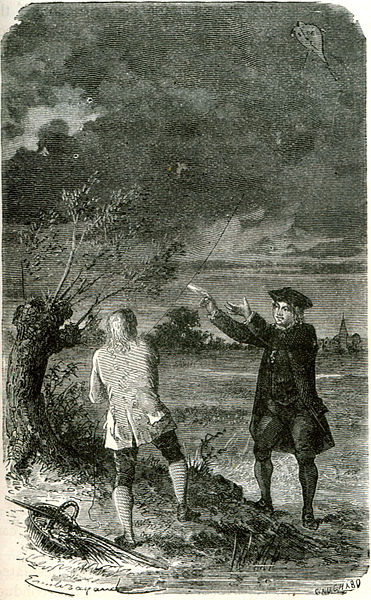
Swimming with Ben Franklin
I headed to the pool yesterday, in mostly sunny weather, but just when I got there, distant thunder could be heard. The lifeguard followed the standard procedure and ordered all the people out of the pool before I could get my toes wet. I didn't have time to stay and wait for half an hour or more, so I turned around and walked home, not getting the 20-30 minute swim I had hoped for.
I wonder whether this risk-averse policy of preventing lightning strikes in the pool makes sense. To answer that question, we need some quantitative measures of risk, not just an explanation why it is risky to be in water in or near a thunderstorm. Of course, being in water increases risk, but by how much? There are indications that expert advice tends to be more risk-averse than most people would be willing to follow. For example, the National Lightning Safety Institute says that cars are safe (because of their metal shell), but only if you
I wonder whether this risk-averse policy of preventing lightning strikes in the pool makes sense. To answer that question, we need some quantitative measures of risk, not just an explanation why it is risky to be in water in or near a thunderstorm. Of course, being in water increases risk, but by how much? There are indications that expert advice tends to be more risk-averse than most people would be willing to follow. For example, the National Lightning Safety Institute says that cars are safe (because of their metal shell), but only if you
close the windows, lean away from the door, put your hands in your lap, don't touch the steering wheel, ignition, gear shifter, or radio.
That means you shouldn't drive in a storm. But how realistic is that? Imagine the traffic coming to a standstill every time a thunderstorm is near. Similarly, if you are at home, you shouldn't take a shower or wash your hands during a storm, because plumbing is part of the house's conductive shield, and touching it - directly or through water - puts you at risk. But seriously, how many people have died or been injured by lightning while washing hands at home?
Numbers matter because foregoing unsafe actions is usually costly. If traffic stopped in storms, there would be significant economic losses, and moreover (if you think money is not worth the risk), parents would be late picking up children from day care and patients would not get to hospitals on time. Not washing hands may increase your risk of getting ill, which may - depending on the numbers - outweigh the risk of getting shocked by lightning. Similarly, in my case, I am not sure if foregoing swimming to reduce the risk of lightning was a net benefit to me.
Exercise is healthy; it improves life expectancy as well as the quality of life. I estimate that half an hour of swimming would have increased my life expectancy by a few minutes. My reasoning for that estimate uses the analogy with smoking. It is often reported that smoking one cigarette shortens your life expectancy by about 10 minutes. (That's consistent with the assumptions that an average smoker smokes 20 cigarettes per day for 40 years and lives about 6 years less than a non-smoker with the same characteristics.) While I have no data supporting this, it seems intuitively plausible that a good aerobic exercise session would improve one's health by about the same order of magnitude as one cigarette would damage it.
Now, my life expectancy is about 20,000,000 minutes, so I should be willing to risk a one-in-a-few-million chance of being struck by lightning to obtain the life-prolonging benefits of exercise. And so far, this calculation doesn't take into account the pleasure derived from swimming. We pursue pleasures involving risk of death every day. Driving 7-8 miles to the mall or theater implies about 1 in 10 million chance of dying in a car accident (and a much higher chance of being injured). 5,000 food poisoning deaths per year in the US amount to about 5 per meal (1 in 60 million), with serious illness requiring hospitalization being 60 times as likely. And I am not even talking about activities that are normally perceived as risky.
What about lightning? It is hard to find relevant statistics. About 1 in 6 million Americans is killed by lightning every year, and about 8% of those deaths are water-related (but 40% are "unknown"). However, a lot of the water-related lightning accidents occur on small open boats, so it is unclear how many are swimming-related. And, of course, most people take safety measures, so it is hard to know the exposure underlying those accident statistics. They don't help with the specific question I had:
What is the probability of being struck by lightning during a single 30-minute swim in an outdoor swimming pool when a thunderstorm is nearby?
If this risk is of the order of one in several million, it is better to swim anyway. If it is, say, one in a hundred thousand or less, the standard safety procedures make a lot of sense.
I could make it more precise by listing several other factors. Lightning was not visible and by the rolling sound of thunder, I am pretty sure the storm was more than 5 miles away. The pool is lower than most surrounding areas, including the pool house. A train station is just about 200 yards away, with various structures likely to attract lightning. There are plenty of houses, trees, and electric lines in the vicinity - it is a densely populated area. It seems to me that all those factors reduce the risk of a direct strike to the pool (and thus of a deadly strike to the swimmer), although some of them might increase the risk of a strike close enough that some charge might find its path through the pool (but this would seem to be more relevant to the risk of lighter injuries).
Does anyone have some relevant quantitative data?
Jul 29, 2008
Facts should be reeducated
The most pernicious mass delusion in America is the delusion that the mainstream media have a liberal bias. The most recent instance is documented in a Gallup poll: 
Americans are more than twice as likely to say media coverage of Obama is unfairly positive as to say it is unfairly negative. For McCain, the opposite is true, with many more seeing coverage of him as unfairly negative than as unfairly positive.
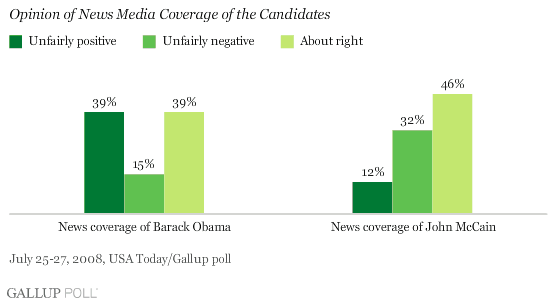
This is as absurd as believing that grizzly bears are harmless fuzzy friends who like to be petted, or that red hair is a sign of moral depravity. It is extremely well documented that the media have avoided challenging McCain's false statements or even cut his most preposterous gaffes out of interviews. There is no way to characterize the belief that the media are unfairly negative in their coverage of McCain as anything other than delusional.
But why are Americans so stupid? Why do they so readily embrace this ludicrous myth of the liberally-biased media? How is it possible for those who spread the lies to convince most people all the time? (Note that the belief is not limited to Republicans or conservatives or McCain supporters: a fifth of intended Obama voters also believe that the media coverage of McCain has been unfairly negative.)
I think it's the fault of those goddamn liberally-biased facts. For decades, the Republican candidates have consistently been so much dumber, meaner, and more dishonest than their Democratic counterparts that it is hard for most people to believe that such pervasive differences are real. Surely, God created the two parties equal, so the vast difference in quality must be an illusion created by the media.
This has an interesting corollary: the best way for the Right to perpetuate the myth is to support incompetent, cranky, and mendacious candidates. And if that's part of the plan, then all I can say is, they are getting more and more successful!
UPDATE: I just found this Daily Kos diary, which discusses the same issue and shows every step of the reasoning - user-friendly for the pedestrians.
Subscribe to:
Posts (Atom)


