Showing posts with label society. Show all posts

Aug 10, 2009

Double-dog-dare you to define my -ism

Arnold Kling wrote a silly little post about progressivism, or rather an idiot's misconception of progressivism. It makes no sense at all: What are "unfettered free markets"? Who are the "technocrats"? What is "optimal"? Such lazy indulgence in empty words deserves no attention.

But then Tyler Cowen took it a step further. He claims he tried to "cast progressivism in the best possible light". He probably did honestly try; he seems like an honest and often lucid thinker. Certainly one of the most lucid thinker of the "right" blogosphere these days. But is he lucid enough for this task? His points seem lame and inaccurate. For example:
1. There exists a better way and that is shown by the very successful polities of northwestern Europe and near-Europe. We know that way can work, even if it is sometimes hard to implement.

You've got to be kidding me. This is the first point of an ideology you are "trying to cast in the best possible light"? A better way for what? "There's a better way" is not basis for an ideology; depending on how you are disposed to interpret those generic words, it is either a truism (of course there is a better way for everything - we humans are imperfect) or mere nagging. And the rest of the two sentences suggests that progressivism is all about imitating "northwestern Europe" (a geographically-challenged characterization?), so why is it then not called "northwesterneuropeism"? Or how about:
4. The needs of the neediest ought to be our top priority, as variations in the well-being of other individuals are usually small by comparison, at least in the United States.

Um, "the needs of the neediest ought to be our top priority" is utilitarianism, which is compatible with progressivism, but by no means synonymous with it. That's something Tyler ought to know (and does know, but he is either too lazy or unable to come up with more precise wording). Or how about:
9. State and local governments are fundamentally to be mistrusted (recall segregation) and thus we should transfer more power to the federal government, which tends to be bluntly and grossly egalitarian, when it manages to be egalitarian at all. That is OK.

Oh, so progressivism is anti-federalism! ("Anti-federalism" is what the "founding fathers" called "federalism", but never mind.) Except it isn't - it's just that, for as long as the US has existed, anti-progressives have touted their fictional concept of "states' rights" whenever it has suited them, which is whenever the federal government happened to be more progressive than the states, which is probably roughly half the time. Whenever it doesn't suit them, those same people conveniently forget "states' rights". By the fallacy that there have to be two equal sides to each issue, progressives, who have no analogous fictional concept, are perceived as "anti-states' rights", whatever the hell that would mean.

Tristero says this is complete bullshit. That may be a bit too harsh, but, obviously, I agree it is not an intellectual exercise Cowen should be proud of. Tristero is also miffed that Yglesias took the bait, and it does seem that Yglesias bent over backwards to "cast libertarianism in the best possible light":
I think libertarianism is best understood as a kind of esoteric doctrine. There’s strong evidence to believe that people who overestimate their own efficacy in life wind up doing better than those with more accurate perceptions. It follows that it’s strongly desirable for society to be organized so as to bolster myths of meritocracy.

I understand that Yglesias is not necessarily endorsing any of this, but merely ascribing it to libertarianism, but the second sentence is written as a statement of fact, so either Matt agrees that it is true, or he is saying that the foundation of libertarianism is simply false. Now I hope he means the latter, but then, if that is the best possible light in which to cast libertarianism, why even bother? He could have said it more concisely as "garbage in, garbage out". Maybe libertarianism should be called GIGOism? But in case Matt actually believes the factual claim to be true, he may be demonstrating poor deductive reasoning.

As far as I know, there is evidence that the most successful people are more likely than average people to be prone to overestimating their own efficacy. However, that does not mean that the converse holds. People who overestimate their abilities may, in effect, be gambling in life, ending up disproportionately at both ends of the outcomes distribution. They will then tend to be overrepresented among the winners as well as among the losers. By observing that most winners are cocky, we learn nothing about the average effect of cockiness. Concluding that cockiness is useful on average is the same fallacy that critics of Larry Summers use to falsely accuse him of stating that men are smarter than women.

But there is an advantage of Yglesias' writing on any topic: he has smart readers, and some of them contribute sensible comments. Thus Keith M Ellis:
A more accurate version of libertarian theory is that it is based upon an idiosyncratic view of inherent (and arguably metaphysical) individual human rights that is strongly oriented to property rights and is extremely American in historical origin and flavor. Sitting atop this view of individual rights—which itself is sufficient and requires no utilitarian elaboration—is a whole bunch of utilitarian justification for a libertarian sociopolitical organization built around the notions that said organization results in the greatest overall material and psychological benefit.

This theoretical basis has three great weaknesses: first, the notion of inherent individual rights is eminently contestable. Second, the almost exclusive emphasis on individual property rights is idiosyncratic and myopic. Third, the utilitarian arguments for the benefits of the resulting sociopolitical organization are extraordinarily simplistic and are as often as not disproved by empirical fact.

In practice, libertarianism is a political philosophy which emphasizes the notion of virtue in selfishness and has as its historical genesis the exceptional American experience. As such, it appeals mostly to white American males who are moderately above-average in intelligence, economically secure, independently-minded, and prefer simplistic theoretical constructs for making political and moral decisions. It validates their own affluence/privilege not by group affiliation, but by inherent individual merit; and it likewise superficially validates the poverty and lack of privilege of others not on the basis of group affiliation, but inherent fault. In this it mimics a meritocratic view, which allows the libertarian to congratulate himself on his lack of bigotry; but, in fact, it is a facade behind which his true bigotry hides.

Or Duncan Kinder:
The problem with libertarianism is that they tend to conflate liberty with possession of property.

This made sense 200 years ago, when owning a small farm or business meant that you were secure in the means of your livelihood. (...) However, due to economic shifts since then, owning property does not mean you therefore are secure in the means to your livelihood. Indeed, large property holders such as medical insurers are very much in the business of interfering with others’ means to their livelihood.

This means that libertarianism now is, in practice, a misguided and often cranky ideal.

Keith M Ellis also says something that especially resonates with me:
I write as someone who thought of himself as a libertarian in my late teens (a self-identification which quickly ended once I met actual, active libertarians)

I'll give Keith the final word:
American libertarianism could have foregone all its academic intellectuals and it would still be largely what it has become with them. Libertarianism is not an intellectual movement, it is a cultural movement. Libertarianism is essentially: individualism, good; property, good; commerce, good; government, bad. It’s a historically/sociologically related set of sentiments.

Jul 24, 2009

Farmers and steelers live twice as dangerously as police officers

There it is - America's most dangerous jobs in 2007:

Also note that police officers' most common cause of death on the job are car accidents, not confrontation with criminals. Police officers' rate of death by homicide - about 8 per 100,000 - is just slightly above the rate for the general population (6.2 per 100,000), and is lower than the rate for general male population (10.0 per 100,000) or male population ages 20-59 (about 11 per 100,000).

Jul 18, 2009

Abort, Retry, Fail?

Tempest in a teapot about an "abortion party" (a fundraiser, actually). Really silly arguments.

Feminists and progressives want abortion to be legal, taken out of the political sphere. Fine. But these goal do not require that abortion be rendered morally unproblematic.
It is true that the pro-choice political position does not require it, but early abortion should be morally unproblematic.
But once again, abortion is not, and will never be, a matter of moral indifference.
And why not?

The woman in the story was having an early abortion. She had just discovered she was pregnant, and was taking steps to abort as soon as possible. (And, don't forget, if abortion were free, as it should be, she wouldn't need to waste time on fundraising and could have the abortion even earlier.) No issues of whether the fetus is conscious or feels pain are even remotely at play. The only reason to make this into a moral issue is religious woo - and that's no reason at all. Such early abortions should indeed become a matter of moral indifference - and that is necessary for the society to have a rational debate about abortion. Forcing early abortion to be a moral issue is the source of all current abortion-related hysteria.

Michelle Cottle makes an utterly irrelevant point about the original story:
in calling the piece "highly dubious," I'm not suggesting the party didn't happen as broadly outlined, merely that (a) this is the kind of piece that smacks of literary embellishment--or at the very least features a situation prone to heavy personal interpretation--in service of a point; and (b) even assuming events unfolded precisely as recounted, the experience is so outside the mainstream that it tells us virtually nothing about sexual relations, much less abortion politics, more broadly.
I don't know if the piece was "literary embellished", and neither does Michelle. But why does it matter whether the experience is typical? The author certainly didn't imply that it was. Interesting observation usually come from unusual experiences. Cottle seems to be concerned that the story will make pro-choice people look bad to "the mainstream", which reminds me of the unprincipled and short-sighted position of the "Neville Chamberlain atheists".

Conor Friedersdorf's question is more relevant, but I think it misses the point somewhat:
But I suspect that the same norm inevitably leads some men to ask -- wrongly in my view, but understandably -- if you think that abortion is ethically unproblematic, and whether to have one or not is your choice, why should I have to pay child support for 18 years if you decide against having one?"
The proper analogy is not with abortion, but with carrying a pregnancy to term and giving the baby up for adoption. That is the situation that challenges the consistency of the current legal rules - the mother can relinquish all legal and financial responsibility for the child in a way the father cannot.

It doesn't make much sense to compare compelling a man to pay child support and compelling a woman to carry a pregnancy to term. The latter is an involvement at a much deeper level, affecting the woman's body and potentially health. But once the pregnancy is over, that distinction is lost. Sure, after a "typical" birth (especially a wanted one), the mother feels a connection to the baby and would be devastated if she had to give the baby away; but we are not talking about "typical" situations, but specifically those where the mother truly does not want to keep the baby (but was not forced to carry it to term). A man would not be forced to raise the child (have custody), and neither should a woman. But a man - even if poor - would legally have some financial responsibility for the child. This is the area where legitimate questions of equal treatment do arise.

Oct 30, 2008

First they came..., 2008 version

First they came for the Muslims,
and I didn't speak up because I wasn't a Muslim.

Then they came for the socialists,
and I didn't speak up because I wasn't a socialist.

Then they came for Palestinian-Americans,
and I didn't speak up because I wasn't a Palestinian-American.

Then they came for the atheists,
and I didn't speak up because I wasn't a atheist.*

Then they came for me,
and by that time no one was left to speak up I wasn't worth speaking up for.

*Well, of course I am. And therefore:

Elizabeth Dole is a stinking turd, but I really do not appreciate Kay Hagan for suing her. The premise behind the suit - that being called an atheist can be defamatory - is extremely offensive. Could I sue somebody for calling me a Presbyterian? If not, Hagan's suit ought to be summarily dismissed.

Let's make a clear distinction here. While Hagan's rebuttal ad is, in principle, also offensive to non-Christians, I understand a politician's need to address voters' concerns. It would be crazy to throw the election away to make a point. I want Hagan to win the election, and I won't object to her doing what she needs to win. The ad fits that role. But a lawsuit doesn't help to win the election. By suing Liddy Dole, she is in fact joining her in insulting all godless Americans.

Sep 21, 2008

Limits of brand loyalty

I can't think of any respectable reason to vote for John McCain in this election, but, according to the polls, 90% of Republicans will vote for him. Is party loyalty a good enough reason? It is a valid reason to support a candidate generally; I certainly weigh ideological proximity more than apparent objective competence when I decide whom to vote for. But this kind of brand loyalty must have some limits. So the appropriate question is, if a Democrat comparable to McCain ran against a Republican comparable to Obama, whom would I support?

To concretize this question, it would be useful to come up with an analogy involving real politicians. That is difficult and subjective, but I think I have come up with ideological mirror images that aren't too distorting.

McCain is a war hero (at least in the sense the term is commonly used in contemporary America) who has, as a politician, been reliably conservative, but has occasionally clashed with, and annoyed, the establishment of his party. He is a loose cannon, whose temperament cannot be described as diplomatic. And, while he is well known, long present on the national scheme, quite witty, and highly popular in some demographic groups, he hardly shows the grasp of issues and good judgment required of the highest office.

His Democratic counterpart could then be a hero of the Civil Rights movement, reliably liberal but in frequent conflict with the Democratic establishment, a sometimes bad-tempered loose cannon, witty and popular with his base, but probably lacking in the grasp of issues and judgment... and someone like that actually did seek the Democratic nomination in the 1980s.

His name is Jesse Jackson.

Suppose Jesse Jackson had won the Democratic nomination in 1984. And suppose his first executive decision - choosing the running mate - turned out as follows. He chose someone complementing him demographically, an outsider unknown to most of the public, but with some enthusiastic followers. A person with some far-outside-the-mainstream ideas and beliefs, who calls himself a Democrat, but critical observers question that. A maverick who would not hesitate to challenge the "old boy network" in Washington, but who also doesn't have much respect for the law. Someone who will not blink in making decisions, but the prospect of him ever making decisions for the nation would scare the crap out of most prudent people...

Someone like... Lyndon LaRouche.

Forget about the utter implausibility of Jesse Jackson picking LaRouche to be his running mate. McCain picking Palin seemed just as crazy.

Would I vote for a Jackson-LaRouche ticket in 1984, running against the conservative visionary and orator Reagan, suspected by critics to be out of the mainstream, but able to inspire and connect with people across ideologies, and his running mate G. H. W. Bush, the experienced Washington insider with a moderate reputation and strong foreign policy credentials? Would I, first and foremost, vote against Reagan, whose ideology could not be farther from mine, and whom I considered a fake and a lightweight?

Hell no. As much as I disliked Reagan, I still required competency and wisdom of his challenger. Mondale had it. Gary Hart had it. (The Rice scandal didn't come until the next election, and as much as it warned of recklessness, it wasn't necessarily a deal breaker.) Jesse Jackson probably didn't have it. The hypothetical Jesse Jackson with a crazy VP pick like LaRouche would not have been even close to having it.

How many Democrats would vote for a ticket like Jackson-LaRouche? I bet considerably fewer than half. After all, look how poorly even decent, qualified candidates like Mondale and Dukakis did. Brand loyalty is much weaker among Democrats as it is; give them a bad candidate and they'll desert him without, um, blinking.

So no, we would not see this stubborn brand loyalty if the roles were reversed. What we see is that today's Republicans are an uncritical herd even by the notoriously low standards of political masses.

Sep 9, 2008

The bullshit of "choosing life"

I have no respect for a decision to carry a Down syndrome fetus to term. On the contrary, I consider it unethical, irresponsible and selfish.

Unfortunately, many staunchly pro-choice liberals go out of their way to express admiration for pregnant women who continue a pregnancy knowing that they carry a severely disabled fetus. Many have falsely convinced themselves that being pro-choice requires respect for every reproductive choice and precludes passing judgment based on the choices others make.

But being pro-choice has never meant that. Many pro-choice people openly oppose abortion on moral grounds. Many would not be comfortable having an abortion themselves. Being pro-choice means supporting the legal right to abortion so that others can make choices according to their own circumstances and moral code. It means not legislating private morality. It does not mean relinquishing moral opinions.

Suppose you are a Catholic who believes that the embryo gets a soul at conception, but, being a reasonable and tolerant person, you realize that others may not share your beliefs and that there is no objective evidence that you are right and they are wrong, so you support keeping abortion legal. I may disagree with your belief (and consider it wacky), but in the mundane deeds - which are what ultimately matters to me - I will gladly be your ally and work with you and respect you. I wouldn't think of saying that you are not really pro-choice just because you see abortion as immoral. But that has to work both ways. As long as I am not legally denying anyone the right to carry a pregnancy to term, I will not allow anyone to question my pro-choice credentials simply because I challenge the morality of those decisions.

So please no bullshit about respecting whatever choice a woman makes. Now let's see, rationally, what happens when a woman chooses to continue the pregnancy despite the bad news.

First and most obviously, she will knowingly impose unnecessary suffering to a human being. Yes, reality does exist and disabled people suffer. And yes, mental retardation is suffering, even if the victim is not fully aware of it. You would probably not argue that advanced Alzheimer's patients do not suffer, would you? (Incidentally, early-onset Alzheimer's is common in persons with Down syndrome.)

And no, the oft-heard argument that most living sufferers prefer to be alive is not relevant to abortion. It retroactively imputes the mind of a formed person to a non-sentient fetus, which is nonsense. The fetus has no meaningful preferences, and that is true whether it is healthy or deformed. "You would rather I didn't exist" is a fallacious emotional appeal that could be used against contraception and abstinence just as much as against abortion. You think sex before marriage is wrong? Oh, so you wish Sarah Palin's oldest son - the one about to be deployed in Iraq - didn't exist!

By the way, if you want to be noble and raise a disabled child, why don't you adopt one? That's a decision I would admire (provided you considered the issue in the next paragraph and ensured there would be no harm, or at least there would be a net benefit). No creating new suffering, but alleviating the already existing.

Second problem arises if there are other children in the family. A disabled child needs more attention than a healthy one. (I assume that the mother who decided to have the child has also accepted the responsibility of giving the child the care it needs.) It is often hard to take proper care of healthy children. With a disabled child, the healthy ones can become neglected. (Of course, the same - perhaps even grater - danger exists for any disabled child already in the family.) Noble attitude to a fetus at 16 weeks of gestation is a very poor justification for unfairness to a toddler.

The third problem affects the broader society. Down syndrome babies become Down syndrome children and, thanks to modern medicine, eventually Down syndrome adults. Most of them are never able to live fully on their own and all of them require extra resources for health care, education, and other support. As our society ages, we will feel an ever greater shortage of caregivers. Every new person needing a caregiver will compete with others for a precious resource. At the same time, more and more women are having children after age 35, so more and more conceptions result in trisomy 21. Currently, the number of people with Down syndrome and other similarly severe genetic defects is too small to require a significant share of total resources, but if the anti-abortion crusaders have their way, the number could easily grow fivefold in a generation.

Testing for Down syndrome is a routine part of prenatal care, especially in older mothers, and when it is diagnosed, over 90% of women choose abortion. Anti-abortion advocacy would imply that those 90% are making the wrong moral choice. We need more voices questioning the decisions of the remaining ten percent.

Sep 8, 2008

Sanctity of shotgun marriage

Here's another reason to oppose gun control: it would destroy the sanctity of that foundation of our civilization - shotgun marriage.

We know Sarah Palin supports abstinence until marriage and that her pregnant daughter will marry the boy who had something to do with that. The boy was displayed last week as an example to all teenagers with raging hormones. Boys, this could happen to you if you knock up a girl: a creepy old presidential candidate will shake your hand and you'll get to stand on the central stage at the Republican National Convention, cheered by a wild crowd of mostly old people. So better watch out.

It's good that they are giving an example to the kids nationwide, but I think it is irresponsible to make two teens marry just because they made a baby. Marriage is supposed to be a lifelong commitment, and 17- and 18-year olds are not mature and experienced enough to decide on such commitment. According to CDC, brides younger than 18 have 1 in 2 chance of being divorced in 10 years and 2 in 3 chance of being divorced in 20. (By contrast, for brides over 25, the chances are 1 in 4 and 2 in 5, respectively.) In fact, I don't think it should be legal for anyone to marry before age 18, but that may be moot in this case, as Bristol Palin turns 18 on October 18. (Good thing teenagers get traffic tickets, otherwise we'd be left to speculate.)

Mrs. Pitt Bull and Mr. First Dude had a similar abstinence story of their own. Their first son was born 33 weeks and 3 days after their wedding, which would pin their elopement at some 2-3 weeks after her first missed period. Seems it was pregnancy test one day, shotgun wedding the next. Sure, they were 24 and had presumably been dating for a while, but it is still a bad way to make a life-changing decision. Wise couples marry when they want, not when they have to.

I will have none of the stupid knee-jerk reaction that those pregnancies and marriages are private matters and not important for the election. If Palin supported reproductive freedom of each individual and sex education grounded in science, I would not be the least interested in her own family planning and would be opposed to discussing any of this. But I am not willing to let her have the same privacy that she would deny to others. Her policy stance makes these private matters fair game.

Private or not, these personal stories provide important information about Gov. Palin's decision making and principles. Her express wedding is relevant because it shows that she let random events control her decisions instead of planning ahead and taking control of events. The speed with which she got married is also significant because it preserved some plausibility for the story that the baby was born just a little prematurely, and that suggests that she may have planned to lie to family and friends.

It is particularly relevant that she publicly opposed sex before marriage despite her own experience. (And what about the fact that, without premarital sex, Track Palin would never have been born? Isn't that one of the standard emotional appeals of the so-called "pro life" crowd?) Yet, she obviously did not persuade her daughter to postpone sex until marriage, so they are now rushing the marriage to bring it closer to sex.

So far, the facts do not bode well for the candidate's judgment, integrity and leadership. And I have not yet touched on the ethical issues with Sarah Palin's fifth child. That indictment of American head-in-the-sand values is coming soon.

UPDATE: Apparently, now she says she supports sex ed and is not for "abstinence only". Flip flop.

Jul 29, 2008

Facts should be reeducated

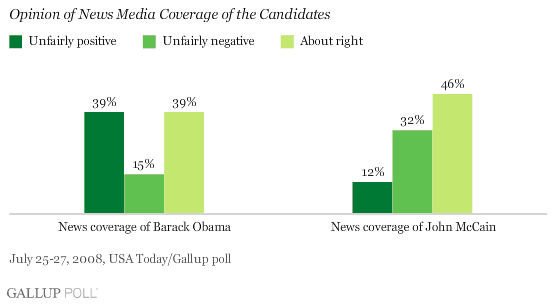
The most pernicious mass delusion in America is the delusion that the mainstream media have a liberal bias. The most recent instance is documented in a Gallup poll:
Americans are more than twice as likely to say media coverage of Obama is unfairly positive as to say it is unfairly negative. For McCain, the opposite is true, with many more seeing coverage of him as unfairly negative than as unfairly positive.

This is as absurd as believing that grizzly bears are harmless fuzzy friends who like to be petted, or that red hair is a sign of moral depravity. It is extremely well documented that the media have avoided challenging McCain's false statements or even cut his most preposterous gaffes out of interviews. There is no way to characterize the belief that the media are unfairly negative in their coverage of McCain as anything other than delusional.

But why are Americans so stupid? Why do they so readily embrace this ludicrous myth of the liberally-biased media? How is it possible for those who spread the lies to convince most people all the time? (Note that the belief is not limited to Republicans or conservatives or McCain supporters: a fifth of intended Obama voters also believe that the media coverage of McCain has been unfairly negative.)

I think it's the fault of those goddamn liberally-biased facts. For decades, the Republican candidates have consistently been so much dumber, meaner, and more dishonest than their Democratic counterparts that it is hard for most people to believe that such pervasive differences are real. Surely, God created the two parties equal, so the vast difference in quality must be an illusion created by the media.

This has an interesting corollary: the best way for the Right to perpetuate the myth is to support incompetent, cranky, and mendacious candidates. And if that's part of the plan, then all I can say is, they are getting more and more successful!

UPDATE: I just found this Daily Kos diary, which discusses the same issue and shows every step of the reasoning - user-friendly for the pedestrians.

Terrorism: right here, right now

Let's be clear: walking into a church with a shotgun and 76 cartridges, and shooting people because their congregation welcomes gays and because most people in it are liberal, is terrorism by any known definition of the word. There is no essential difference between Adkisson and a suicide bomber who blows himself up in a cafe because he believes the patrons' country shouldn't exist. That equivalence does not depend on Adkisson's sanity; many terrorists may be insane to various degrees.

So how do we fight this battle in the "War on Terror"? Do we send Rush Limbaugh to Guantanamo? Do we waterboard Ann Coulter? Do we listen to phone conversations of every subscriber to the National Review? The absurdity of those propositions is not out of line with current policies. The concept of a war against terrorism has always been absurd.

Terrorists are dangerous criminals and we need to approach them as such. At the same time, we also have to work on building a society that is not conducive to breeding and fostering terrorism. That's not a war, but a quest.

Jul 28, 2008

Orlando magic crackers: the saga continues

Wafers of Mass destruction aren't going away. Webster Cook, the student who "kidnapped Christ" is facing possible university disciplinary action, and his friend, whom he wanted to show the wafer, may be in trouble as well. Ed Brayton has the story and the link to the president of the University of Central Florida. I have sent my appeal for an immediate dismissal of all religion-based complaints, and I urge you to do the same.

Meanwhile, Freethought Radio has an interview with Cook (it starts about halfway through the segment). Cook, who is 19, sounds articulate, calm, and polite. The interviewers were rather provocative and snarky at times, but Cook kept his calm and stuck to recounting the events seriously and responsibly. If you suspect that he is a brat and an irresponsible prankster, listen to the interview and you'll probably change your mind.

Besides, he was introduced as a double major in Economics and Actuarial Science, which counts as a big plus here on Gnash Equilibrium.

Jul 24, 2008

Hate is love. Ignorance is bliss.

What does a bunch of homophobic thugs do to a gay man?

They rape him.

What I'd like to know is how they achieved and maintained erection.

Jul 22, 2008

Jul 15, 2008

Wafers of Mass Destruction

There is a near-consensus among reasonable people that the people in the church and the Catholic League overreacted insanely in the cracker-kidnapping case. A lot of people, whether they like PZ Myers or not, agree that his job, let alone his physical well-being, should not be threatened because of his commentary of the case. But it seems to me that most people would still chide the student whose refusal to eat the Communion wafer started the incident. Several people with whom I talked or corresponded have described the student's action as unethical and disrespectful, and therefore deserving some condemnation, although not anywhere on the scale of threats and attacks to which he was subjected.

I think this is an important issue: was the student "wrong" at some level? Not wrong in the sense of violating the internal rules of his religion, which he obviously did, and for which the Catholic Church may discipline him (without breaking laws) however it wants, perhaps even excommunicate him. But was he ethically wrong from a secular point of view? Did he do anything harmful to people, rather than just to a god or gods? Let me go through a list of complaints people have typically raised over his actions:

1. He stole the wafer, and there has to be something wrong with that. No, he didn't. The wafer was already his when he "abused" it. It was given to him as part of the Eucharist and he was supposed to eat it, not return it. He couldn't steal it once it was his.

You may wonder if the Church, nevertheless, retains ownership of the wafers it hands out, as software manufacturers retain ownership of the programs you buy from them, whereby you only buy a license to do certain things with the software. But the software license agreement is a legal contract, and no such contract exists here. (Church rules may apply, but I've already disclaimed any discussion of internal church issues.) There is no property contract that complicates the case; no theft could have occurred. (If it had, I wonder what the value of the stolen item would have been. A nickel?)

2. He disrupted a solemn and peaceful ceremony. People have compared his action to yelling "Bullshit!" during church service or preaching about salvation through Jesus at a Wiccan gathering. I think those analogies fall flat. Yelling "Bullshit!" (or even "Hallelujah!", for that matter) while the rest of the congregation is praying or listening to a solemn sermon is objectively disruptive---the yeller temporarily prevents others from doing what they gathered to do, and they can't easily ignore his noise. But all the student did was take the wafer out of his mouth as he walked away from the altar. One would not expect others to even notice it, unless they are more interested in looking over and policing their fellow parishioners than in receiving the Body of Christ (or whatever other spiritual benefit they get from the Mass).

3. He acted disrespectfully toward a sacred object. Some people have compared it to defecating on the Bible or the Qur'an. Besides the analogy being grossly disproportional, I think it misses the point of deliberately offensive acts: they only mean something if somebody knows about them. A provocateur who uses the Qur'an as toilet paper will do it in such a way that somebody (a Muslim, he hopes) will notice: he'll probably use a public rest room, he might not flush, or he might leave a damaged copy on the rest room floor. If he does it secretly, it will not insult anyone and, consequently, it will be ethically irrelevant. "Desecration" of an object cannot be unethical in itself, but only through the anguish it brings to people who hold the object sacred. That brings us back to the previous point---disruptiveness. Provided that the student tried to save his wafer discreetly (which nobody seems to dispute), neither disruption nor desecration should be an issue.

4. He acted in bad faith by participating in the ritual if he knew he was going to break its rules. There are several versions of this argument. One---that he wasn't entitled to receive the Eucharist in the first place---is easy to dismiss. All parties agree that he is, in fact, a Roman Catholic and can take Communion. The reason he was saving the wafer was to show it to his non-Catholic friend who was curious about it, which also implies that the friend did not pose as a Catholic to get to the wafer. Perhaps they even considered the possibilities and decided that the way they eventually chose was more honest (or less risking to become disruptive)?

The version of the "bad faith" argument worth considering is that, while he was entitled to participate in the ritual, by such participation he implied a guarantee that he would complete the ritual properly. Put this way, it is not just about church rules, but about general trust. If I host a party at my house raising funds for Obama, and you show up, it is reasonable to assume that you will not try to persuade other guests to vote for McCain or Nader, and that you will not drive the guests away by some persistent misbehavior. This kind of trust is important because it enables us to deal with a lot more people than just our families and best friends, and not be constantly on a lookout for those who would take advantage of our hospitality or outreach. Therefore, a breach of trust by not following implicit agreements on behavior can be a secular ethical issue. But, before we conclude that it always is an ethical issue, does the breach need to be serious enough? Are perhaps some minor breaches immaterial?

In the fundraising party example, suppose a guest behaves fine, but doesn't give a contribution (or gives less than the suggested minimum)? If it was explicitly announced that contributions would be voluntary, but most people understand they are expected, would this be unethical behavior? What if a guest is boring and somewhat annoying, although not doing anything that can be identified as inappropriate? While I'd expect the guests to be helpful to the cause, I also shouldn't have unreasonable expectations. Or, what if the party is in a very backwards, redneck community (yes, there are redneck Democrats, and the candidate does not want them written off) and a guest shows up with his or her gay partner? At some point "trust" can degenerate into a community's intrusion into individuals' basic rights.

There is no doubt that the student did violate the trust of the Church when he went to take Communion. But was the breach material, and were the requirements for trust reasonable? I am not sure I can answer those questions until I ask informed Catholics to educate me. Here are some questions I have for Catholics:

1. Many people are only outwardly religious---they want to fit in their religious community, but don't actually believe in God. Should a person who is formally Catholic, but really a non-believer, take Communion? Is such person's partaking in the Eucharist a breach of trust?

2. How about Catholics who do believe in God, but don't believe in the real presence of the Christ in the Eucharist? I am sure that millions of Catholics think of the "Body of Christ" as a symbol, a metaphor, although that clearly contradicts the Church dogma. Are those people partaking in the Eucharist in bad faith and desecrating it?

As I said, I don't know the answers for sure, but I expect that the answers are that neither group should be taking Communion, that both are "cheating" the Church in doing so, and that they are, from the Catholic Church's point of view, at least not paying due respect to the sacrament, and probably desecrating it as well.

If it is so, then I would like to know how the student's "kidnapping" of the wafer is any different from those people's participation in the sacrament. And I wouldn't be surprised if those two groups made up half the people who were taking Communion together with the student. If bad faith was his only transgression, he probably has abundant company in every Mass.

If anything, his stated goal was more honest and socially useful: he was satisfying a friend's curiosity. Curiosity is a noble goal in itself, and a lack of curiosity should be considered an ethical failing. I would expect that most Christians whose churches have a regular Communion ritual do something to examine the Communion wafer at least once, presumably at a young age. It seems like a healthy child's or teenager's thing to do. Not exactly a behavior to be encouraged, but whom is it ever going to hurt? And satisfying a friend's curiosity ought to rank higher than satisfying one's own. Of course, in this case, the curiosity seems frivolous, and perhaps not age-appropriate, but even so it compares favorably to concealment of one's true beliefs.

Admittedly, the student almost certainly also belonged to one of the two "wrong belief" groups, otherwise he probably wouldn't have kept "God" in a Ziploc. So he double-cheated! But what is the difference? If either bad-faith issue meant he shouldn't have taken Communion, two of them have the exact same effect as one: he abused the trust and entered the ritual he wasn't supposed to. There is no further increase in harm from his second breach, the saving of the wafer.

So I would conclude that the student committed the same kind of unethical act that millions of Catholics commit weekly - a bad-faith partaking in the Eucharist. I can't see that the Church suffers any harm from those millions, so I doubt that this one caused any harm, either. That would make the unethical act minimal and negligible, barely deserving as much as a friendly admonishment.

He also may be guilty of clumsiness to the extent that he wasn't discreet enough and other parishioners saw him taking the wafer out of his mouth. From the news report it is only clear that one person saw him, and made a scene; other people might not have noticed anything without the ruckus. It is possible that his behavior was somewhat reckless and indiscreet, but I would need some evidence of that before jumping to such conclusions. In the article, there aren't even allegations of him flaunting his wafer or something like that.

OK, so much for his behavior during Mass, but what about the next several days? The student himself cited as one of the reasons for returning the wafer that he realized some people were upset, even pained, because he was holding on to the wafer. Doesn't this mean that what he was doing was causing pain to others, and was therefore unethical?

I think that such notions have to be firmly rejected. If we accepted that one person's "desecration" of the Eucharist was causing pain to other people because it offended their beliefs or their sense of sacred, and that the person's acts were therefore unethical, then we would also have to accept the same argument against abortions, homosexuality (with or without marriage), atheism, or even religious diversity. And that is just the beginning of the list. I know some people would be quite happy with that conclusion, but I would not want those people's ethical principles anywhere near me. In fact, I eat a lot of garlic to keep them away.

Jul 14, 2008

I Support PZ Myers

PZ Myers is an associate professor of biology at the University of Minnesota, Morris, and the author of the very popular Pharyngula blog. He is currently under attack by the Catholic League president Bill Donohue and his followers.

The case began with the news of a student in Orlando, FL, who attended Mass and took a communion wafer with him instead of swallowing it. He then received threatening messages, and the church filed an official complaint with the University of Central Florida against the student. The student also alleges he was physically attacked while trying to keep the uneaten wafer. The church's overreaction involved calling the student's act "hate crime" and "kidnapping" and procuring armed UCF police officers to stand guard during Mass to protect "the body of Christ".

PZ Myers, an outspoken critic of any belief in the supernatural, known especially for his criticism of religious excesses related to evolution, but also in other contexts, wrote a commentary on his blog in his characteristic sharp and provocative style, in which he exposed the hypocrisy and perverted moral priorities of those (including Donohue) who have made the incident into a high-profile national issue. He ended his post with a satirical request that the readers send him consecrated communion wafers, which he would then treat "with profound disrespect and heinous cracker abuse". That angered Donohue so much that he called his followers to write to the University of Minnesota (and even to the MN legislature) to demand Myers' resignation. Not surprisingly, Myers has also been receiving numerous threats of physical violence.

While Bill Donohue obviously doesn't speak for most Catholics, he is very influential among the extreme Catholic right, and he and his followers are very vocal and active, so I expect that the president of the University of Minnesota has been getting a deluge of angry letters and e-mails. PZ Myers has asked his readers to send polite messages of support to the president. Many other liberal bloggers (some of whom are known not to like Myers' style) are urging their readers to support Myers.

I wrote a letter to the president of the University of Minnesota, expressing support for Myers. Here it is:
President Robert H. Bruininks
202 Morrill Hall
100 Church Street S.E.
University of Minnesota
Minneapolis, MN 55455

July 13, 2008

Dear President Bruininks,

I wish to express my support for Professor P. Z. Myers, whom I deeply respect for his tireless promotion of science, scientific education, and a scientific worldview.

I am concerned that Professor Myers is, apparently, being threatened by some overzealous individuals who accuse him of offending their religion. If I understand correctly, some of those individuals have written to you demanding that Professor Myers be disciplined or even fired. Those demands are terribly misguided and I respectfully urge you to reject them.

Professor Myers' blog post that angered those people was itself a reaction to the news reports of a student who was harassed, threatened, and possibly assaulted, all for his improper handling of a Communion wafer. Our society's civilization norms do not condone abuse of persons as retaliation for merely symbolic offenses, and Professor Myers was rightly indignant at the treatment to which the student was subjected. His commentary was an appropriate and fair criticism of the abusers and an expression of solidarity with the victim. While it is not surprising that those whom he criticized detested his writing, that cannot justify their attempts to silence him.

Professor Myers' writings for general public are thoughtful, engaging, and highly valuable. University of Minnesota should be proud to have him on its faculty.

Sincerely,
(signed)

If you are familiar with Myers' writings and comfortable with supporting him, feel free to copy as much as you like from my letter. If you are not familiar with him (or not enthusiastic about his style), please consider sending at least a brief e-mail message to Robert H, Bruininks, President of the University of Minnesota; his e-mail address is bruin001@umn.edu. Even a very brief message such as "I support Professor P.Z. Myers" or "I support Professor Myers' rights to free speech" can make a difference. As Mr. Bruininks is probably getting tons of e-mail, it would probably help to give the message a descriptive title, e.g., "Support for PZ Myers".

Oct 18, 2007

Required Reading on Race

In a comment on Pharyngula, Lance perfectly illustrates the universal folly of human nature. Quoted in full:
Being a white guy married to an African (Ethiopian) woman I have read along with great interest and occasional amusement. Having visited the African continent on three occasions certainly doesn't make me an authority on the intelligence of its residents but I have had the good fortune of interacting with a great number of African people in Africa and here in the US.

I personally know a good many highly intelligent Ethiopian folks. What is funny is that they disparage the intellect of their African neighbors of different tribes. The dominant "highland" tribes of Ethiopia and Eritrea, the Amhara and the Tigray attribute lower intelligence (and bigger penises) to their southern "low land" neighbors the Anyuak, Walita, Omo and the Jinka. They look down on them as "baria" or black people.

There are over eighty separate tribes and languages in Ethiopia alone. Some of these tribes have been genetically separated for thousands of years and are quite visually distinct from on another. Even a "farange" like me can easily identify the physical characteristics of many of these distinct populations.

Are there true differences in intellectual ability between these tribes? I have no idea but I kind of doubt it based on my interactions with the people from these different groups. What I find interesting is that the different tribes have definite opinions of the relative intelligence of each tribes.

They have recently been exposed to Chinese workers and engineers and have decided that they are very intelligent as a "race" if revolting in appearance.

Having been immersed in their very hospitable culture I can say that people are people and this whole topic is interesting at first blush but quite absurd in practice.

Oh, by the way they think we "faranges" are about as bright as the highland tribes but much less civilized. After spending time in their society I tend to agree with them.

Ignorant, Stupid, or Deluded

In a certain context (Which Shall Not Be Named), we often hear that you can't expect to be taken seriously if you assert that a great majority of Americans are ignorant, stupid, or deluded. People seem to assume it just can't be true, and refuse to examine the evidence that it is. But that assumption is wrong, and here is proof, in a different context.

In the Oct 13 LA Times, Jonathan Chait reminded us that
A poll in late 2001 found that 76% of Americans preferred Bush over Gore as a war leader.

Now, is there any way to explain this other than to admit that, in late 2001, 76% of Americans were ignorant, stupid, or deluded?

Oh sure, they could have also been malevolent. But evil doesn't exist as a Platonic form, so malevolence itself requires some explanation, and a reasonably charitable and optimistic first approximation is that it is usually caused by one of that obnoxious trio - ignorance, stupidity, and delusion.

Oct 16, 2007

Naughty Lama

From the news:
When asked if he had a message for Chinese President Hu Jintao, the Dalai Lama playfully patted a reporter on the cheek and said, "You are not a representative of Hu Jintao."

Cute. No big deal. Really. But wait, would anyone else doing the same be described as sympathetically? Suppose George W. Bush "playfully patted a reporter on the cheek"? Or, god forbid, if the reporter was female, imagine Bill Clinton in Dalai Lama's place. Wouldn't the press describe the "incident" as "harassment"?

(If the reporter was male, try Senator Larry Craig.)

Oct 4, 2007

Deep-Sixing the Sixth?

I wish there were no trials by jury, at least not by jury of citizens with no qualifications for critical thinking. Out of 12 randomly chosen people, at least 8 have either no ability or no will to consider evidence without prejudice. And it is difficult to get juries to convict in cases of police brutality or vigilante vandalism. But the Sixth Amendment guarantees the right to jury trial (and the Seventh does it for civil cases), and it would be almost impossible, as well as unwise, to change that. So what is to be done?

We could have professional or semi-professional juries, as some other countries do. Contrary to the popular misconception, there is no constitutional (or otherwise recognized) right to trial by jury of one's peers. On the contrary, the concept of "peer" is rooted in aristocracy and thus repugnant to our constitutional principles.

A reform to introduce trained juries would be difficult, and would increase the cost of government, but it would greatly improve the integrity of our judicial system. It could also enable a compromise between those who want elected judges and those who prefer appointed ones. We could have appointed judges and elected jurors. And states could experiment with various flavors of such reforms.

Another feasible reform could be doing away with "guilt" as the issue in a trial. Rather than decide if the accused is "guilty", the jury would decide whether the accused "did it". Objectively, this may be just a difference in words, but framing matters, and many people would probably perceive their role differently, as objective fact finders rather than judges of value. That could quell the annullment-by-jury tendencies, which usually have the effect of letting abusive cops and vigilantes off the hook.

Sep 21, 2007

Conversation With Ed Brayton

Looks like I struck a nerve just enough and not too much: Ed Brayton wrote a long response to my previous post. It is a good response; he holds no punches, but doesn't hit below the waist. I think we have a decent conversation going, and, naturally, I disagree with various points he makes, so here goes my response. I'll address it directly to Ed, in second person. You (Ed) wrote:
The fact that it's "exactly like Dawkins" hardly changes my disagreements with Dawkins on the broader picture, especially on that subject. What human being, even someone deeply religious, would not agree with the statement that "religion provides a structure for people to divide into opposing camps, define themselves by membership in a camp, and kill the members of the other camp"? For crying out loud, Pat Robertson would have to agree with that statement; it's too bloody obvious for anyone to deny.

That's far from clear. Maybe Pat Robertson would say that all of those divisions and killing would be avoided if all people chose the right religion. Some religious people certainly would. Some others, not necessarily religious, would say that religion is incidental to those divisions, with no relevant role in generating them. Not Dawkins; he says religion is central to some of the world's most dangerous divisions. You seem to agree, at least with respect to Irish history. My point was that this is not a trivial agreement.
More importantly, it's not really a counter-argument to the claim that religion benefits the community. Only the staggeringly simple-minded think that there is a single simple answer to the question of whether religion benefits the community.

We agree here; the differences are purely semantic. So it isn't a counter-argument; it is a contrary statement that must be included for a truthful description.
Just as it is absurd to pretend that religion has nothing but positive effects, it's equally absurd to pretend that it has nothing but negative effects.

Right, but the symmetry is broken in American reality. The former pretense is the norm of public discourse, while the latter is considered impolite and offensive. In recent years, several authors have tried to rectify this unjustified asymmetry by giving public voice to the "impolite" side. Although such expression has a long tradition in America, from Tom Paine to Robert Green Ingersoll to H. L. Mencken, its recent professors have been called "new atheists".
Neither the name nor the classification seem very meaningful, but it has caught on, mainly because some other atheists have emphatically distanced themselves from this ill-defined group. And a similar division has arisen among those who defend science education from creationist subversion. I had implied that the two camps differ in how diplomatic they are; you say I am wrong:
The distinction between the two camps has nothing to do with being diplomatic; there is a serious, substantive disagreement between the two camps.

I am sure there are substantive disagreements, but I doubt that the flame wars and personal attacks on blogs can be explained that way. I think people tend to be much better at sorting out substantive disagreements than some barely perceptible character incompatibilities. It is also significant that the deepest hostilities arise between fellow nonbelievers and not between a believer and an atheist, who would tend to have deeper substantive disagreements.
I have one and only one concern and that is what is true. If I think an idea is absurd, I obviously have no problem whatsoever slamming it in very blunt language.

OK, but PZ Myers could have written the same thing. And Dawkins could have (and probably has) written the same first sentence. (He doesn't use "very blunt language", FWIW.) If you don't agree on what is true, perhaps it would be worth figuring out how to resolve the disagreements.
it is about the substantive question of whether religion itself - as opposed to the many stupid or repulsive beliefs within religion - is inherently absurd or dangerous. It isn't that I don't think it's diplomatic to call belief in God a delusion; it's that I honestly don't think it's delusional to believe in God.

The wisdom of Stephen Hawking's retort "I do not answer God questions" is validated if one observes that "God questions" are full of semantic traps that look like substantive issues. Is it possible that much of your disagreement is semantic? Both "religion" and "delusion" are used with so many meanings and shades of meanings that it is extremely easy for two people to talk about them and talk completely past each other, because they don't have common definitions of words.
Dawkins takes steps at the beginning of his book to avoid such misunderstanding, clarifying that he does not use "delusion" in a technical, psychiatric sense, and that the "religion" he is talking about does not include systems of belief, such as Unitarian-Universalist, with no doctrine about supernatural entities. But that may not be enough to avoid misunderstanding completely. After all, Sam Harris, another "new atheist", targets "faith" but not "religion"; in his understanding, "religion" requires neither dogma nor the supernatural. It may be that one has to write an entire book just to define one's terms enough to avoid most misunderstandings.
Now, there are particular conceptions of God that I think are inherently ridiculous and I criticize those ideas here every day.

I agree. But once you take that position, you ought to allow that it is not unreasonable to hold a similar position with a different threshold of ridiculousness. It is also not necessarily true that more ridiculous ideas lead to more dangerous behavior. I've sided with Cal Thomas against Hillary Clinton intellectually, but if I had to choose one of them to make important decisions, it's slam dunk for Hillary.
there are also beautiful, inspiring and, yes, true ideas to be found in religion as well.

Dawkins must hold the same view; if he didn't, then his strong support for teaching the Bible in schools - as literature, of course - would make no sense.
Just as religion can motivate almost unspeakable barbarism, it can also inspire great kindness. For every bigot quoting Leviticus to justify beating up gays, there's someone like my stepmother, a fundamentalist Christian who, while she believes homosexuality to be a sin, nonetheless spent years taking care of my uncle while he was dying of AIDS. And she did that because she takes seriously Jesus' words, "Whatever you do to the least of these, you do unto me also."

That is clearly evidence that your stepmother is a good and kind person, but it is only circumstantial evidence for the positive role of religion. Like every Christian, your stepmother cherry-picked the parts of the Bible that suited her. (It is impossible to avoid cherry-picking because the Bible is too diverse and self-contradictory.) You dismiss the bigotry of Leviticus as if it was struck out of the Bible like the "3/5 of a person" abomination was struck out of the Constitution. But it was not; Leviticus is no less sacred to Christianity than the Parable of the Sheep and the Goats (which, BTW, ends with a threat of eternal punishment, but OK, let's limit it to your quote). Your stepmother was driven by the latter because it fit her kind personality. But it does not follow that her religion caused her kind deeds. What role, if any, religion plays in that, is not a well-understood topic currently. (Note that the moral metaphors by themselves are not religion, in the sense Dawkins uses the word, without supernatural origin and retribution after death. Religious inspiration is presumably qualitatively different from inspiration from poetry.)
I simply know too many brilliant, well-educated people who believe in God to say that belief in God is an indication that someone lacks intelligence.

That's a straw man. Nobody relevant has ever made such a claim.
I've known too many good Christian people who spend their lives feeding the homeless, taking care of foster children and orphans, hiding political dissidents from death squads, etc, to believe that religion is uniformly bad.

And that is non sequitur. There are many good religious people (just as there are many good nonreligious people). That doesn't mean that religion made them good. It may have; but any such statements are mere conjectures at this point.
To give one obvious example, at the same time that some in the Catholic hierarchy were cooperating with the Nazis, hundreds of brave priests and nuns were hiding Jewish families from them, risking their own lives in the process. And I don't see how stupid arguments from creationists or vile statements from anti-gay bigots cancels that out.

And I don't see what there is to cancel out. Again you have people doing good deeds; and you and I agree that they are good deeds based on secular criteria. They may have been motivated by religion, but that is speculative. However, I challenge you to try to explain how the persecution of Jews would ever have happened without religion, Christianity in particular. Antisemitism is probably the most readily identifiable negative consequence of Christianity.
It simply doesn't have to be "religion is good" or "religion is bad"; religion is both.

Sure, but you can say that about everything. Love. Death. Democracy. Fascism. It means nothing without assigning it some value on the (possibly multidimensional) good-bad continuum. Which way does the balance tip?
And we can criticize all of those bad things and the ridiculous arguments used to rationalize them away without advocating, as PZ did recently, the "obliterating of religion."

Yes, we can, but what makes one approach inherently better than the other? Assuming that the balance tips toward "bad", would it not be reasonable to at least consider the desirability of disappearance of religion? (It wouldn't necessarily be desirable, it might still be better to preserve religion in a "safe, legal, and rare" form.)

As you see, we have considerable disagreements, probably many of them substantive. But I don't think you are an idiot or a dangerous person and you probably don't think I am. I don't think your opinions should be censored and I can't imagine you'd think mine should. Maybe this discussion can serve as a catalyst for ceasefire in some other web disagreements. As the commenter Sastra wrote on your blog about you and PZ:
But I love them both and want them make nice to each other. Won't hold my breath, though.

Perhaps Sastra and I can start a petition?

Jun 16, 2007

A Third of Americans Disagree with Themselves

I am finally getting around to commenting on this poll, but I will not dwell on high numbers of Americans who reject evolution (alas, I already know that) or the particularly high numbers of Republicans who do so (gee, whoda thunk). What caught my eye was this table:
(Scroll down if you see a big white space, I haven't figured out how to eliminate it.)


View of Evolution and View of Creationism
Numbers Represent % of Total Sample


View of Creationism


Definitely
true

Probably
true

Probably
false

Definitely
false

%

%

%

%

View of Evolution

Definitely true

3

1

2

11

Probably true

5

14

12

3

Probably false

6

8

1

1

Definitely false

24

3

*

1

* Less than 0.5%


I commend Gallup for publishing this 2-dimensional table. In press releases, pollsters rarely show data along more than one dimension at a time, which makes it difficult to discern any correlations. And there are some amazing finds in this table.

If you sum up the numbers in the four cells in the top left quadrant, you find that 23% of Americans say that both evolution and creationism are definitely or probably true. (Actually, Gallup states the fraction as 24%, probably correcting for rounding errors.) It is logically possible to disbelieve both (e. g., one can believe that non-divine space aliens brought us to Earth), and 3% of respondents took that position, but how do you believe both theories? Was the question asked in a way that presented them as compatible? Let's see:

Next, we'd like to ask about your views on two different explanations for the origin and development of life on earth. Do you think -- [ITEMS ROTATED] -- is -- [ROTATED: definitely true, probably true, probably false, (or) definitely false]?
A. Evolution, that is, the idea that human beings developed over millions of years from less advanced forms of life
B. Creationism, that is, the idea that God created human beings pretty much in their present form at one time within the last 10,000 years

While the question does leave a lot to be desired (introduction talks about the origins of life on earth, but both options mention the development of human beings), it is impossible to interpret the two options as logically compatible. You can't say both are true without violating the laws of logic. So, 24% of respondents made no sense!?

It is worse than that, actually. If you consider one of the theories to be "definitely true", you must, logically, consider the other "definitely false". So everything above and to the left of the diagonal is logically inconsistent. That is 6 cells, not just 4, and the percentages add up to 31%. Almost a third of respondents couldn't answer the two questions without contradicting themselves!

Much to my chagrin, the evolutionists, as a whole, did no better in the logic department than the creationists: in both camps, about a third of "definitely true" supporters and more than half of the "probably true" supporters violated logic. Worse yet, as there are fewer "definitely true" evolutionists, the total percentage of logic violators is actually somewhat higher among evolutionists (49% to 45%).

What could be the reasons for such massive inconsistency?

Some people may genuinely contradict themselves, but I doubt that they account for a significant part of the 31% logically challenged.

A lot more people could have misunderstood the questions. Too much information may have been packed into those two questions, and a rather narrow version of creationism is described (young-earth creationism). A lot of people actually believe in both evolution and creation to some extent, just not in the variants described. (More about those people in a bit.) If they didn't listen to the questions past the first words, they might have thought they agreed with both.

The results could be biased if people tend to give answers they think will please the investigator or sound agreeable. Since there was no neutral option (distinct from "no opinion") given, those who really think that "the jury is still out" had to choose between a weak positive and a weak negative opinion. And the actual responses break overwhelmingly in favor of weak positives: 35-16 for evolution, 27-16 for creation. As for the options available to true fence-sitters, double "probably true" beats double "probably false" 14 to 1. I think this bias accounts for something, but it is hard to believe that there could be so many people sitting on the fence without even leaning to one side.

Finally, the explanation may be in the people whose views differ from either option, but have something in common with both:

A separate Gallup Poll trend question -- also asked in May -- gave Americans three choices about human beings' origins. Responses to this question found that 43% of Americans choose the alternative closest to the creationist perspective, that "God created human beings pretty much in their present form at one time within the last 10,000 years or so." A substantial 38% say human beings evolved, but with God guiding the process. Another 14% favored an interpretation of evolution arguing that God had no part in the process, leaving a total of 52% who say humans evolved with or without God's direction.

52% is remarkably close to the 53% who, in the two-way poll, say evolution is definitely or probably true, and one would expect that theistic evolutionists would choose one of those answers. On the other hand, the two theistic views (creation and theistic evolution) account for 81% of respondents, which far exceeds the 66% that said creation was definitely or probably true. But that, too, is to be expected, because theistic evolution and young-earth creationism are mutually exclusive. The surprising result is not that the support for creationism doesn't gain 38% from the 3-way to the 2-way poll, but that it gains anything substantial, let alone 23%.

So, do the theistic evolutionists explain the supporters of both views? Not entirely - for example, fewer people are in the "definitely evolution, definitely not creation" corner than support non-theistic evolution in the 3-way poll - but a reasonable case can be made that most of the strange, illogical answers are due to theistic evolutionists. If about 60% of them didn't pay attention to the full description of creation, and heard only the part they agreed with ("God created human beings"), practically all of the double-support puzzle would be explained.

If it is implausible (and even offensive to the theistic evolutionist group) that 60% would have attention span shorter than 5 seconds, there is an almost equivalent, but more plausible and, possibly, less condescending explanation. Most people have a really hard time thinking in terms of probabilities, and a statement like "A is probably true" means to them something very different from what it means to me or to Gallup pollsters. I would automatically read it as "The probability that A is true is between 50% and 95%". (The upper limit of the range is the only unclear piece - should it be 90%? Or 99%? Maybe 99.99%?) But such numerical probabilities would mean nothing to many people; to make sense of the original statement, they may need to reinterpret it as "I somewhat agree that A is true." Of course, it means something quite different, but if your language doesn't have words for certain concepts, you make do with the best translation you can find (or make up).

If I am on the right track, there was a miscommunication between the pollsters and a substantial number of respondents. Those respondents changed the meanings of the answers: "definitely true" became "I agree strongly", "probably true" became "I agree somewhat" and so on. Such people could hold any of the substantive views probed by the poll; in most cases, there won't be any effect on the results. But take a theistic evolutionist who has to evaluate creationism. He believes that God created humans, by guiding the evolution process or intervening in it, but doesn't believe it happened as recently as literary interpretations of Genesis suggest. If he understands the options given by the poll, he will say that creation is definitely false (or probably false, if he is not so sure that Genesis is not literally true). But if he reinterprets the options as I think is likely, he can easily choose the option that, to him, sounds like "I agree somewhat", even if he is absolutely sure that the earth is billions of years old and that humans have emerged hundreds of thousands of years ago. After all, how significant are some numbers compared to God's act of creation?

To summarize, if 60% of all people can't think probabilistically, and that percentage is about the same among theistic evolutionists, the misunderstanding between pollsters and respondents can account for most of the anomalous result in the 2-way poll.

It's still depressing. A third of Americans contradict themselves, and most of those are unaware that they do.